Florida’s Sad Happy Ending
James Fishback celebrates defeat
By Toby Smollett · October 7, 2026 · 21 min read
As I drove through verdant forest along Highway 98, crossing flat cement bridges over spring-fed rivers, I was nervous that my parents would call me, as they are wont. They would adopt a disapproving tone of my traveling to Tampa for a failed candidate’s election party on the pretext that I “might write about it”; they would be nervous that I had no plans for the night, that I would end up booking a shady motel that would endanger my person while costing them money.
But most of all, I dreaded the phone call from my father, a Reagan Republican, vehement anti-Trumper, and devout Catholic who had followed Pope Francis to the bleeding edge of social justice. “That freaking racist,” he would say about someone like Fishback. “Why would you go see that freaking racist?” He is an anti-MAGA Boomer, despite being a devoutly religious law enforcement officer, and I am an anti-commie Millennial, despite having a PhD and editing a lit mag. But oddly, our anger emits the same scent, stings with the same burn. We agree the country is being ruined, but the devil is in the details.
Twice, I turned around near the turnoff for the lighthouse. It would be ridiculous to drive five hours to an event I would be late to where I didn’t know anyone. I live in rural Florida, isolated, alone—and here we are getting closer to the real topic at hand—I yearn for adventure, for what is vital and virile, despite being born too late for it. So I put the keys in the ignition and set out for the “Victory Party” of underdog gubernatorial groyper James Fishback.
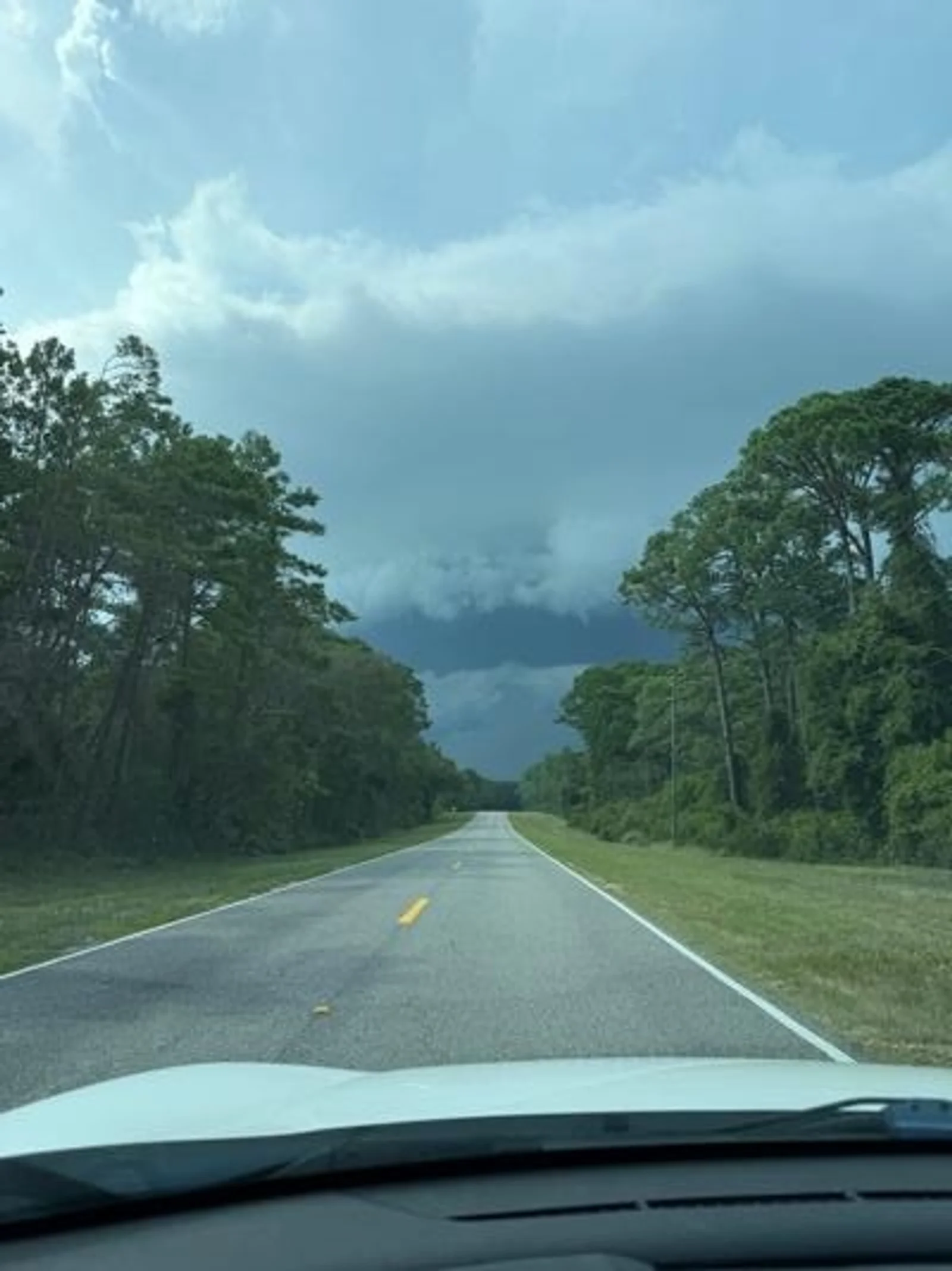
My Times-crossword-loving mentor was on my mind as I turned into Rocky’s gas station outside Perry. I did not want my face enshrined in virtual perpetuity at this right-wing event. I would buy a hat. If one was trying to not be recognized in photos, if one was trying to still be published in reputable literary magazines, a hat was essential. I dashed through the rain to the store. The “Dirty South” and “Old South” camo hats looked perfect for an undercover fed.
“You know these are two for five?” the heavyset cashier asked.
I got a second White Monster. The guy working the pizza counter was wearing one of the Dirty South hats; it looked okay on him.
On the drive, I thought of calling a buddy who calls me on the regular since separating from his wife. I didn’t feel like telling him where I was going even though he’d understand; he’s more sensitive to antisemitism now than in college. The dead gas stations and empty mid-century motels of Perry went by; the buzzards circled. It’s a wasteland, the armpit of Florida. This flat, cursed, miraculous state.
By the time I was in Cross City in monstrous rain, I was regretting the trip, feeling like a real schlemiel. Around Chiefland, my 2hollis song was interrupted by a predictable call from my parents. I hit the gas and let it ring. They left a voicemail saying they were calling for a weather report—another layer I’d have to lie about. I’d passed from being mad at myself into despondency and dread. The only way out was through. I stopped for a piss, and the urinal had terrible backsplash. My right foot had a blister on the heel from driving in my slip-on Skechers. I texted my parents that yeah, the weather was crazy. My foul mood was in part because the latest issue of my literary magazine had been a flop in terms of sales, despite its obvious quality. There was a restlessness, a misbehavior, a procrastination; I couldn’t sit down and face my to-do list. I was on the lam from a pathetic life.
Approaching the toll road north of Tampa, I knew that if the SunPass mounted on my front windshield scanned, my mother would get a text notification on her credit card. I double-checked the science of hiding toll road RFID passes in gloveboxes while I drove, and AI informed me that some rental agencies put them in aluminum bags. I took the pass and slid it into the plastic bag between the empty Monster can and the Monster I hadn’t opened yet, and stuffed my invention in the glove box.
The sunset tossed curls of peach creamsicle into the treacherously gray-blue sky. Just after 8 PM, I turned on the NPR One app to face the preliminary election results, which I knew would further devalue my trip, but an elaborate discussion of the Florida election did not even mention Fishback. I checked the Times app on my phone, which confirmed that Fishback had lost. I continued forth Quixotic, tilting at windshields.
The topic was, ostensibly, in my wheelhouse; after all, I had “studied white people” in graduate school, a milieu prone to lifestyle experimentation. Even before the Trump phenomenon, in 2014, I was in the Ivory Tower peering down over the lip of canned Perrier onto my research topic, “the rural white,” dabbling in proto-Trumpology. In 2017, I taught a course at my elite university, a popular course, really the course of the year, “White Identity Politics.” I had kept an eye on Frogtwitter; it was my expertise.
At a moment when so many young anthropologists were from the cultures they studied, Punjabis studying Punjabis, Syrians studying Syrians, I had transformed myself into a white guy studying white guys—surprise, everybody! Boy, have I got a fun idea for us all—and I became an uncanny mirror, a parody, a farce, an alarm. I presented myself as a leftist, believed myself to be one. I was like Arlie Hochschild, author of Strangers in Their Own Land, the Berkeley sociologist who made friends with the white working class in Louisiana; it was all above-board. I had a concept, post-rural white identity politics, that described how rural signifiers were used on social media to politically mobilize exurban and suburban counties. I said that the mullet, the fish not the haircut, which generations of poor Floridians had consumed before the gill-net ban, was a quasi-ethnic object used to express “Poor White Identities,” ergo whites were quasi-ethnic, ergo they had a place at the grievance table, too; Poor Whites are the subaltern, too, bro. It was all a bit much for Trump 1.0, too unpleasant, impish. “It’s reactionary,” one Guggenheim Fellow said, not long before our committee parted ways.
My dissertation was not trolling—it was, rather, a delicate performance art piece that presented a vexing ambiguity: it could plausibly be trolling, and plausibly not. The professors had not known what to do. They decided not to host the customary celebratory dinner at my defense, and instead, the day after my defense, my advisor, a black woman, invited me to coffee. “Normally there’s a dinner,” she said with a knowing chuckle. I had driven them nuts, but had my charms.
Now, of course, I can’t even get an academic job at the University of Austin, the anti-woke university built on Palantir money, perhaps because I’m not up to snuff, perhaps my unsightly dissertation was a defense mechanism, perhaps I had chosen to fail in Wokeland; I had failed my anti-woke-Palantir-bag-securing interview, for sure, blabbering on about the next five books I wanted to write, yapping about my untouchable theory that Franz Boas, the founder of cultural anthropology, the man more responsible than anyone for the global uptake of “race is not real,” was a communist and fraud; and now, in my poverty and isolation, I had terrible resentment towards the elites who had almost let me join. I was even angry at my once-cherished public elementary school in little old Tallahassee, with its rallying cries to Save the Rainforest, the Herstory exhibits by the lesbian librarian, singing the old slave song, “Follow Yon Drinking Gourd”—if you ever find yourself enslaved, use the Big Dipper to guide you North to freedom; and remember, moss grows on the north side of trees. Now I saw the propaganda, now I reveled in podcasts by the podcast bros; I had reconciled myself to the great stench of my biography. My dissertation had been cockamamie, the anthropology department had been a parody, even my high school teachers had been raving ideologues. By golly, I’d been taught lies! My old anthropology department was no longer taking white people or men, as far as I could tell; a recent class of PhD students had been entirely women of color. I’d been on the last train out of the station; an idiot and ally and fool; I was a downwardly mobile, over-educated, white kid from the burbs that couldn’t stop thinking about tomorrow. I was open to dating, open to work, open to revolution! Open to the FBI opening a file!
The Hilton Tampa parking lot was full, so I had to drive through a world of ticky-tacky corporate boxes to the Kona Grill, which, from the parties lingering in the parking lot, seemed like a place where swole chads went on double dates.
I feared that as I walked through the automatic doors, protestors would be arrayed with their phones out, ready to dox. I thought of the American Indians who, right in front of the man on horseback dressed as Florida Territorial Governor Andrew Jackson during the Springtime Tallahassee parade in my childhood, would run out in front of Jackson and spill a cooler of tomato-juice “blood” while banging drums.
I recognized, from photos on X, Fishback’s neck-tatted bodyguard returning to the conference catacombs from the buzzing lobby. He did a double take of me. I walked down the hallway towards the conference area, where a long line of Zoomers in suits were assembled, no ties, many pencil mustaches. I was fatally mogged in my esoteric Florida T-shirt, given to me by the mullet fisherman Jonas Porter protesting the environmentalist gill net ban that had decimated the fishing industry. On its back was a photo of a white egret eating a green frog that was gripping a distressed American flag. The egret was the spirit of freedom; the green frog was the Florida Fish and Wildlife Commission; the flag the frog squeezed was the God-given rights of the mullet fisherman.
We represented two of the largest constituencies in the room: frat guys and incels, an awkward alliance. Some of the most social and least social men of the same generation were converging on the same point.
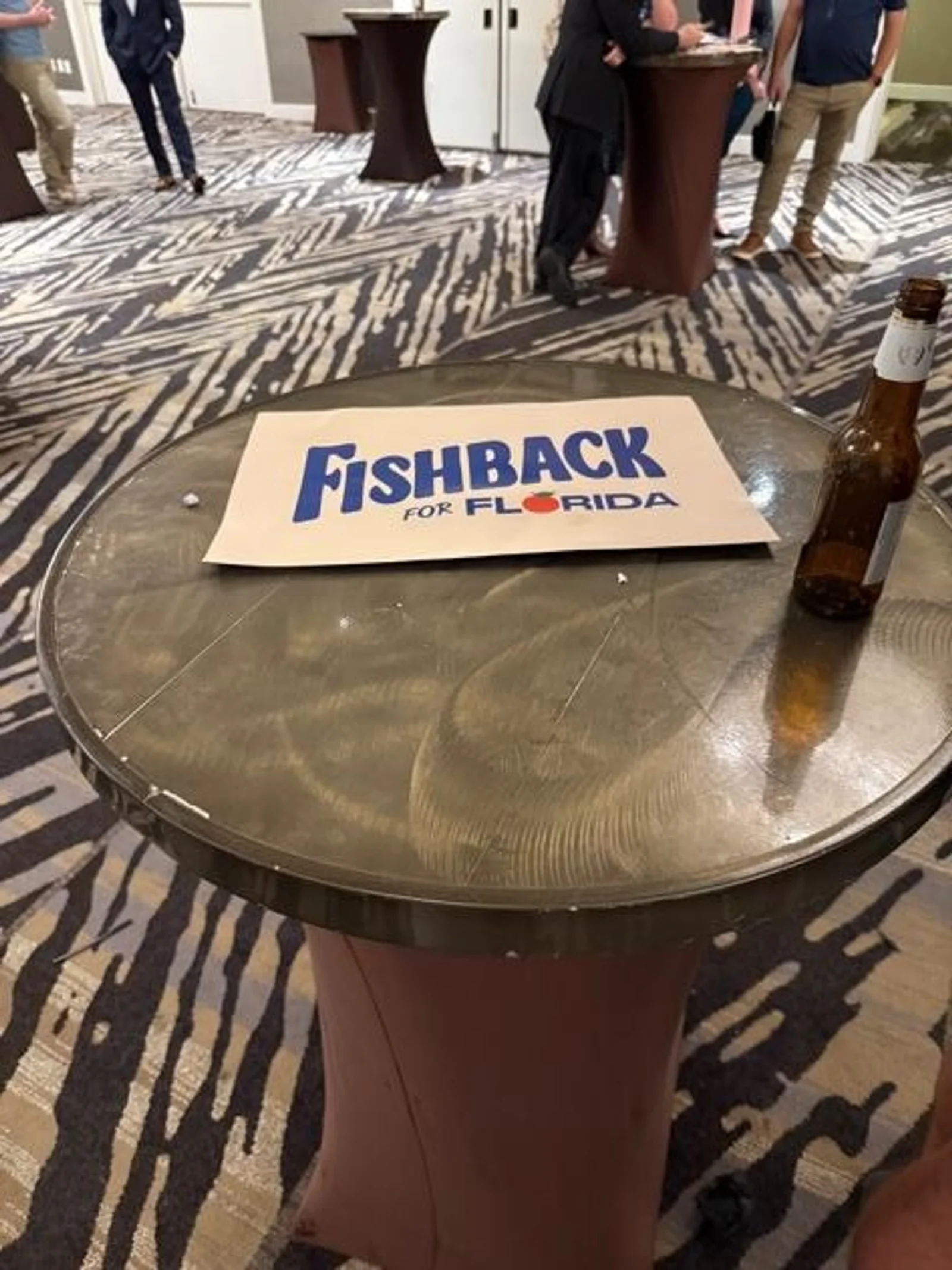
The sea of fascistic twinks brought me back to college, when I would go to parties at the apartment of a guy who would become DeSantis’s press secretary; he had a suit of armor and a snake around his neck; it didn’t need to be boring to be right-wing; if you were rich enough, it could be glamorous. I peeked my head in the ballroom; it was nearly empty, a few bottles strewn on tables, a stage with abandoned Fishback signs glistening beneath lights. I avoided a professional cameraman panning the wasteland. I looked down somberly and scratched an itch on my face when I saw a woman panning with her phone. I went to the end of the line and asked a young Latino guy in a black suit vest what the line was for. Photos, he said. I had no interest in that. I went for my hard-earned piss; defeated, underdressed, feeling emasculated by winsome Zoomer patriots. I slipped back into the dead ballroom and stood by a cocktail-hour table, looking at the results on my phone. This would not do. I scanned for a bar.
“You still open?” I asked the waitress, a Latina in her sixties.
“Jes,” she said.
“Bud Light, please… Actually, let’s make that a Coors.”
“Jes.”
“Did he already speak? The candidate?”
“Jes.”
“Gotchya.”
“Did he win?” she asked, cracking open my not-gay beer.
“Can’t you tell from the somber atmosphere?”
Another guy at the bar had huge arms and pecs filling a black Fishback T-shirt. Fishback baseball cap too, available for $55.
“Did you catch the speech?” I asked him.
“No, I just got here,” he said. “I’m Ziad, by the way.”
“Cool name. Where’s your family from?”
“They’re Christians from the Middle East.”
“Big Fishback fan?”
“Oh yeah,” said Ziad. “I expected him to at least get second place.”
“Did you volunteer?”
A morose nod.
“Did you make the 500 phone-bank calls? I saw they advertised that a few days ago as the only way to get into this party.”
“I made the calls and recorded the videos. Over 1,000,” he said, pulling up the app on his phone to show me the proof. “I recorded one while taking a shit.”
“Florida has so many Boomers,” I said, trying to comfort him. “You can’t win Boomers without cable, and you can’t win cable if you’re a groyper.”
“Fishback was the only candidate who was America First,” Ziad said. “When Trump won in 2016, he didn’t just win young people; it was a larger movement.” He was looking at the bar without buying anything. “Beer is so expensive.”
I offered to buy him a beer. He said no. He looked around the room for someone else to talk to. Two guys pulled up, presumably because we were in the way of the bar.
“Hello, Fishers,” said the blond one in an untucked white button-down shirt.
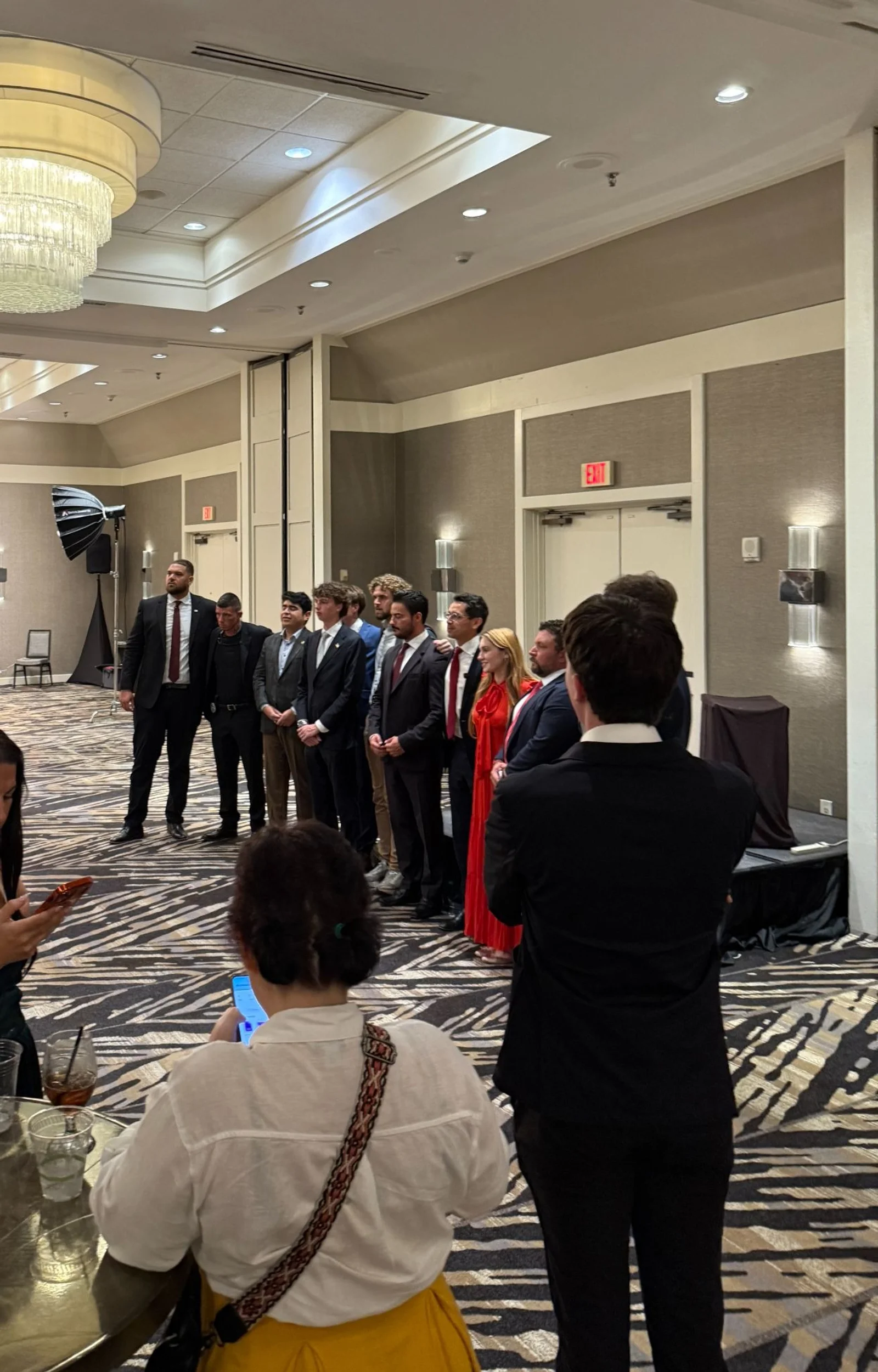
We represented two of the largest constituencies in the room: frat guys and incels, an awkward alliance. Some of the most social and least social men of the same generation were converging on the same point. All of a sudden, people were being redirected to stand right by us. A volley of Fishback fans—the photo line—was being moved from the dark, cramped hallway into the huge, expensively rented ballroom. And there, across the room, appeared the candidate himself, an all-smiles greeting machine, internet made flesh.
I steeled myself with another Coors. It had proved a depressing excursion, but it was getting slightly less depressing now that the ballroom was alive again. I continued my guilt-induced charm offensive with the bartender, who at least appeared oblivious to the anti-immigrant sentiments in the room; although, of course, the candidate himself was a Colombian American, and it showed; his skin tone was similar to the bartender’s.
I walked along the new snaking line and was soon sandwiched between some hippie types with long hair and some young, besuited groyper operative types, neonatal purveyors of fine pencil mustaches, who were making jokes about how one of them was Jewish. “Of course a subversive movement of high verbal intelligence is going to have plenty of Jews,” I overheard, and it was true, one of the grandfathers of the Zoomerwaffen, Bronze Age Pervert, is reportedly a gay Jew. I didn’t eavesdrop for long.
A guy closer to my age in a breezy green Hawaiian shirt with long, curly blond hair—the hippie type—had turned around and introduced himself as Sergei. We discussed development and quickly identified our common cause: conservation. Sergei was telling me about plans to build a data center in West Palm. Land was so expensive down there, the thought surprised me.
“Donalds is in the pocket of the developers,” he said, explaining how Trump’s anointed gubernatorial nominee, Byron Donalds, had spoken positively about data centers.
“Florida has too many people,” I said.
He agreed. He told me he had an Instagram account where he promoted conservation. The two of us were perfect examples of what Richard Hanania called Fishback’s “Florida Nationalism.” What Fishback himself has called “Florida First.”
While Fishback puts an economic populist twist on such sentiments—proposing, for example, to lower property taxes on Floridians while keeping them high on out-of-staters with second homes, alongside raising taxes on tourists (proposals that would fit Zohran Mamdani’s lips), the core of “Florida First” is preserving Florida. This is more expansive than merely protecting the state’s environment, but also preserving the state’s culture, its lifeways and traditions, even simply the memory of the state just a generation or two before. Floridians see so much growth so fast, many of us experience the state as a horror show of destruction. To live in Florida for one’s entire life is to live through a spectacle of deforestation.
My pro-mullet-fishing protest shirt was a perfect example of this: catching and eating mullet was a way of life out of “Old Florida.” This stance resonates especially in North Florida, where state legislators can run on slogans like “preserving rural Florida.” Byron Donalds, the pro-development New York native who lives in ritzy, aloof Naples, was terrifying to Sergei and me both: a vision of data centers everywhere, growth at every cost, corporate victory at every turn. The guy next to Sergei was talking about voting for David Jolly, the top democrat candidate for governor. I heard that throughout the night, the whisper in the room: everyone would be voting for David Jolly. The sentiments didn’t seem to be merely sore wounds, or racial bigotry, but a fear that Donalds was a generic out-of-stater who would sell Florida down the river.
“If you’re so passionate about the environment, why not be a Democrat?” I asked Sergei.
“I don’t know why people think environmentalism isn’t conservative,” he said.
His attention went to Sean Lozano, Fishback’s running mate, who was working the end of the photo line. A South Florida cop, younger than me, Latino with dark features. There was a crowd of maybe six of us, and everyone was being supplicative while Lozano offered his platitudes. “We ran a strong campaign, we turned out so many folks.” I nursed my watery beer. Sergei pulled out his phone. He recorded Lt. Gov. Boy as he delivered the pat lines, and I was clearly in the frame, my nightmare realized. I stepped back and snuck out of the frame, landing near the only black woman in the room.
She and I bonded over avoiding the camera. She said friends at school would give her grief. We were giggling, more or less. Only later did I remember that, when conducting ethnographic research in February 2016, I had gone to a Trump rally in Valdosta to observe the phenomenon and had befriended a Valdosta State student, also a young black woman, who seemed to be there simply because it was something to do; we had met by laughing over her ogling a hot Secret Service guy at the metal detectors. It was almost muscle memory from my Obama-era youth, when I was a good Democrat, to ally with stray black women in inappropriately right-wing settings.
Truth was, people in the ballroom were operating on different levels of knowledge, different levels of initiation. A bartender had never heard of Fishback. Some normie Floridians brought in by pet issues—data centers, Flock cameras, abortion, H-1B fraud, Iran—surely knew that the campaign was racist around the edges but kept their eyes on the slopulist prize. The candidate did visit all sixty-seven counties in Florida, popping up in Waffle Houses in tiny, neglected towns. There must have been some America Firsters of the jejune variety, alienated MAGAlytes, who were more hardline on immigration than Country Club Republicans but who still, presumably, had moderating tendencies. And then there was the nasty undercurrent, fascists walked amongst us, it could not be denied. The angel-faced youths flirting with repealing the 14th and 19th Amendments. The edge, of course, was what made it fun; without it, imagine the bore! A decadent, hedonistic, laughing embrace of rage; precisely what makes it a young person’s game. Rebellion against (((The Man))). It was surely a boost to one’s ego to seduce the oblivious into a lion’s den. “If only you knew,” lingered lustfully on whispering lips. Either Fishback’s #1 black female fan was a character for the history books, or she didn’t know up from down.
“Mr. Fishback,” I said, shaking his hand.
He cocked his head with familiarity and opened his arms like a Sicilian grandpa welcoming the prodigal son. He radiated peace. He could have been mistaken for a groom on his wedding night, a role he had recently played. I put my left hand over his left hand, all four of our hands becoming an amorphous Southern European amalgam of affection. It was also an extraordinary failure of proper dapping.
“You stood up for multigenerational Floridians,” I said.
He smiled and nodded.
“Ten percent is respectable,” I said.
“Over 170,000 voters,” he replied, replacing my figure with his own.
I took our selfie. His guard tapped his shoulder. I thanked him and went back to my black woman, who was standing idly.
“You gotta get in there,” I said.
“You’re right,” she replied. “Which side of my poster should I have him sign, the blue side or the beige side?”
“The beige side,” I said. “It will help the Sharpie stand out.”
Was this the moment I noticed her braces? She walked up and asked him to sign. Seeing her blackness, he shot a subtle beckoning glance to the campaign photographer. Here, even in the heart of Anti-DEI-land, we couldn’t escape the same Three-and-a-Tree strategy of every mid-2010s university administrator. America has the most inclusive racists on Earth. In America, you can be racist no matter your background; being multiracial provides no meaningful barrier to leading a major white supremacist organization, not in this nation. Being gay doesn’t stop you from being a homophobe, or attending and covering a Fishback event. Even Jews can be Nazis in the ol’ U.S. of A. You can’t have a land of dreams without nightmares—that’s sleep science!
The bar counter had been swept clean, and the candidate was leaving. I said goodbye to my black friend, who said she had a two-hour drive and school in the morning. I walked, slowly lingering, down the hallway, where the campaign staff were running in and out of a smaller conference room. Another guy in a suit with a tie with tiny eagle emblems started a melancholy chat about how it was all over. He also had a two-hour drive home; mine was even longer. We stopped in the lobby for cucumber water. He had just dropped out of a seminary affiliated with an obscure Protestant denomination. He was trying to leave the church to join another seminary in a few years. It sounded like a tricky situation. He wasn’t from Florida, and he was considering just moving back home.
We were standing outside under the overhang, already having determined our cars were in opposite directions: two lonely men who had traveled hours to this celebration of failure, neither satisfied with his lot in life. We met Ziad in the parking lot, also dissatisfied and alone. The three of us talked about the seminarian’s dilemma. Would he stay in Florida? He wanted to book some time at his job before he leapt, if he did.
Two black rental vans pulled up, presumably to take the campaign to the afterparty. That was where I wanted to be, but I had no reason to be invited, no reason for them to trust me. Plus, there wouldn’t be cocaine there anyway. Barely anyone had drunk. Barely anyone was legal to drink, and they had been too busy clipping Fishback on X, as far as I could tell. We stood there, the Christo-fascist, the underemployed incel, the lapsed Cathedral academic. What a sad little trinity we made.
We said our goodbyes, and I walked across the little bridge over the subtropical drainage ditch to the Kona Grill parking lot and, while a couple necked in a car two spots down.
Defeated on my phone, defeat being the night’s theme, I drove eleven minutes to Mr. D’s Leather Emporium, parking on dirt under trees in an empty lot that looked like Marjorie Kinnan Rawlings’s mossy backyard. There weren’t any hot guys, so I left, sat back in my car, steeled myself for the five-plus hour drive home, but I couldn’t bear another dry night. I live in the middle of nowhere and when I leave the middle of nowhere, I really need to get laid. I went back inside. On the back patio there was a guy I hadn’t noticed the first time, a young Latino. He had dyed ginger hair, a Stones shirt, camo cargo pants, and was hitting the cart. We locked eyes and then I stood up and pulled up my chair next to his. He asked why I was in town. He didn’t know who James Fishback or Byran Donalds were. He was waiting to hear back on a community college acceptance, living at home, wanting to study finance, but he didn’t know any more about finance than he knew about Fishback and Donalds. “You wouldn’t believe the mud I waded through, searching for a man who would give Old Florida the shirt off his back,” I said, and waited for a laugh. He shrugged. We walked into the shadowed alley running behind the bar and jerked each other off.