Three Days in Skid Row
Is the World’s Worst Drug Slum the Result of Evolution or Intelligent Design?
By Joe Garza · July 23, 2026 · 14 min read
Come November, Los Angeles will have to choose between a candidate who wants to let Skid Row fester like an untreated infection — and a candidate who wants to let Skid Row fester like an untreated infection.
“They must feed on Skid Row’s inhabitants,” I think. “That’s why local leaders keep the problem going, to drain adrenochrome from their pineal glands, extract rare nutrients from their starving bellies, and get high from their drug-addled nervous systems.”
There’s a line from H.P. Lovecraft’s short story, “The Festival,” which perfectly describes L.A.’s City Hall: "Great holes secretly are digged where earth's pores ought to suffice, and things have learnt to walk that ought to crawl.”
An art deco beauty that secretly houses a cavernous, cannibalistic, conspiratorial cult of slimy lizard things in human form, telling the masses that the city is on the right track, all while dealing in snakepit politics where manipulation and self-preservation are dressed up as civic duty.
But I’m willing to keep an open mind.
*****
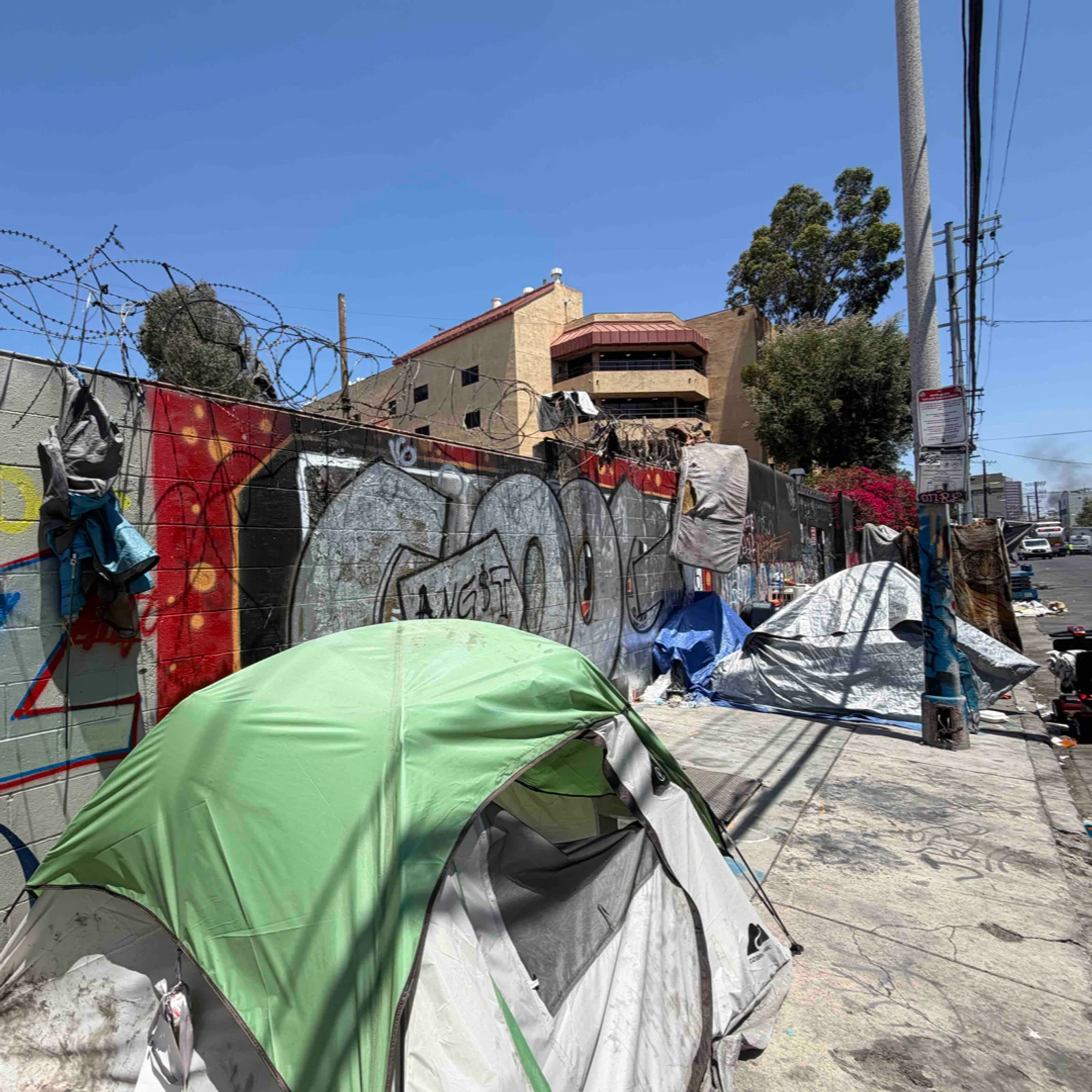
No matter how developed your instincts are, it’s not a good idea to head into Skid Row alone, which is why a few of us – connected through Latinos for Pratt – volunteered to venture into the neighborhood together. Skid Row was a focal point of Pratt’s run, and we wanted to see for ourselves just how bad things were.
Is Skid Row really just rank with human misery? Are homeless people really being paid to vote? Are they really shipped in from out of town, all to profit the nonprofits?
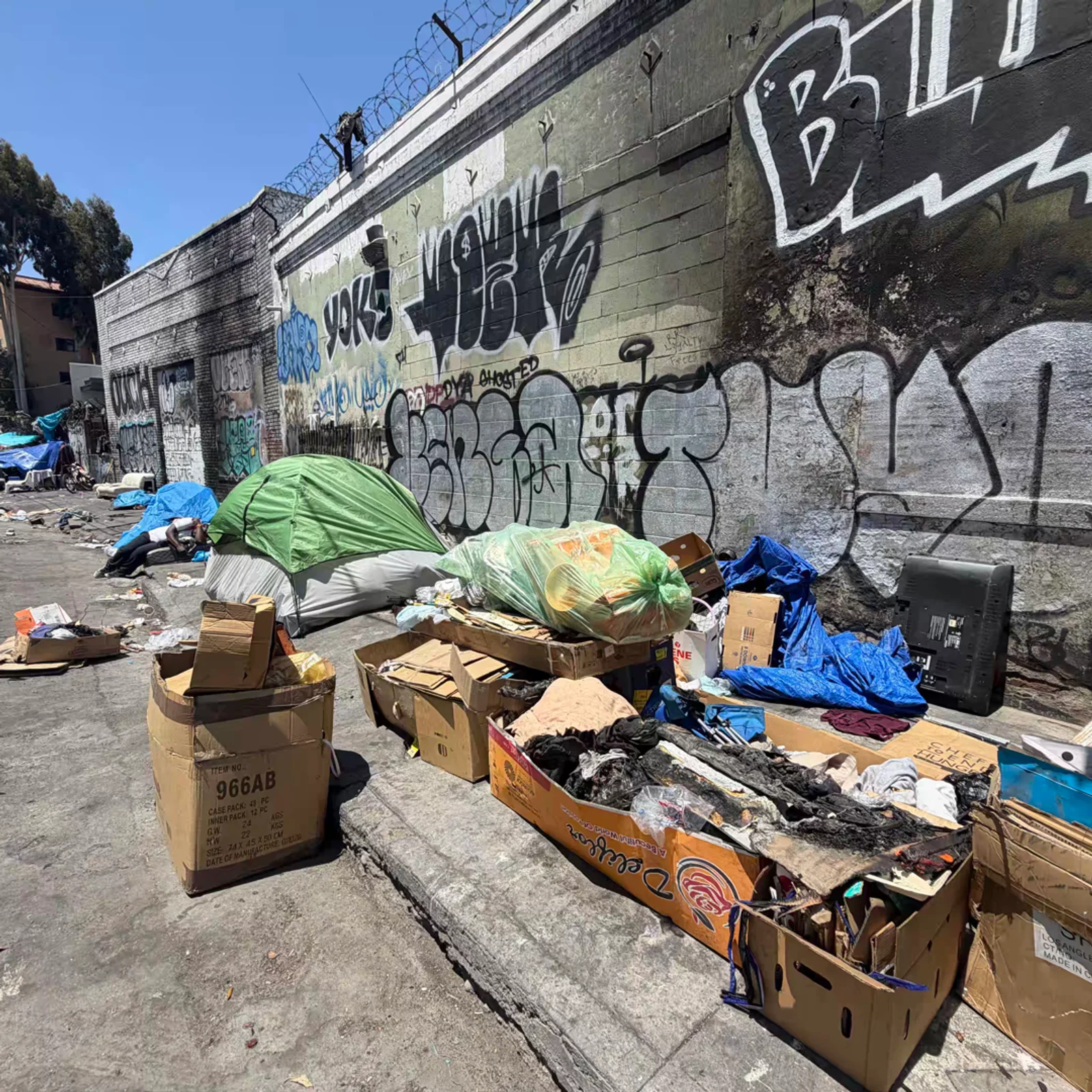
We parked ourselves on a stretch of San Julian between 6th and 7th Streets, a short block littered with encampments and garbage. There were broken hypodermic needles, empty Whip-It! cannisters, a smoldering street fire. To make ourselves feel a bit better that we weren’t just cashing in on human misery, Chris set up a gas grill to cook hot dogs and pass out bottled water to residents.
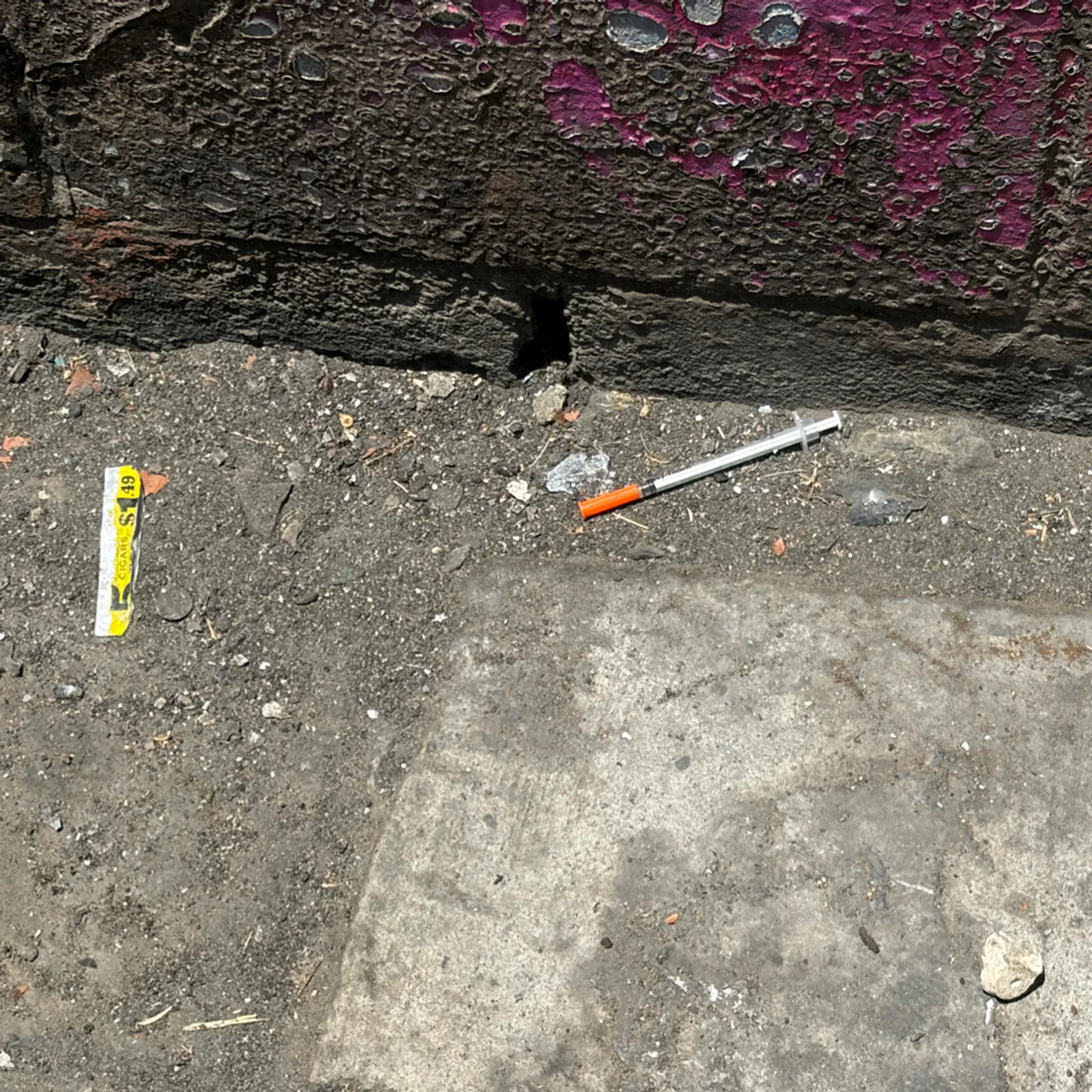
DTLA air is already thick with exhaust, but Skid Row is layered with the funk of human waste, burning trash, and chemicals. There’s a smell there that’s only there; sweet and intrusive, fecal and antiseptic at the same time.
The “residents” of San Julian were – like those in the rest of Skid Row – a varied and eclectic bunch. They visited each other’s tents, socializing like suburban neighbors; they rummaged through piles of debris, fixing up their living quarters with dirty blankets and tarps; they aimlessly walked around, pushing carts overflowing with detritus, sat on their own intensely talking to themselves, and lay out on the hot pavement under the burning sun.
A couple of guys casually carried out a drug deal right in front of us.
A campfire flared up, died out, reignited.
A youngish homeless couple asked us if an empty tent was being used; we told them no, and they scurried in like excited hermit crabs.
First responders whizzed by every few minutes, performing a siren-symphony soundtrack to this Third World street in a supposedly First World city.
A sign caught my eye:
OPERATION HEALTHY STREETS
The City of Los Angeles will be conducting enhanced cleaning and trash removal in compliance with relevant laws in this ZONE. No tents shall be erected between 6 a.m. and 9 p.m. No Blocking of the sidewalk, exits/entrances, driveways, or loading docks.
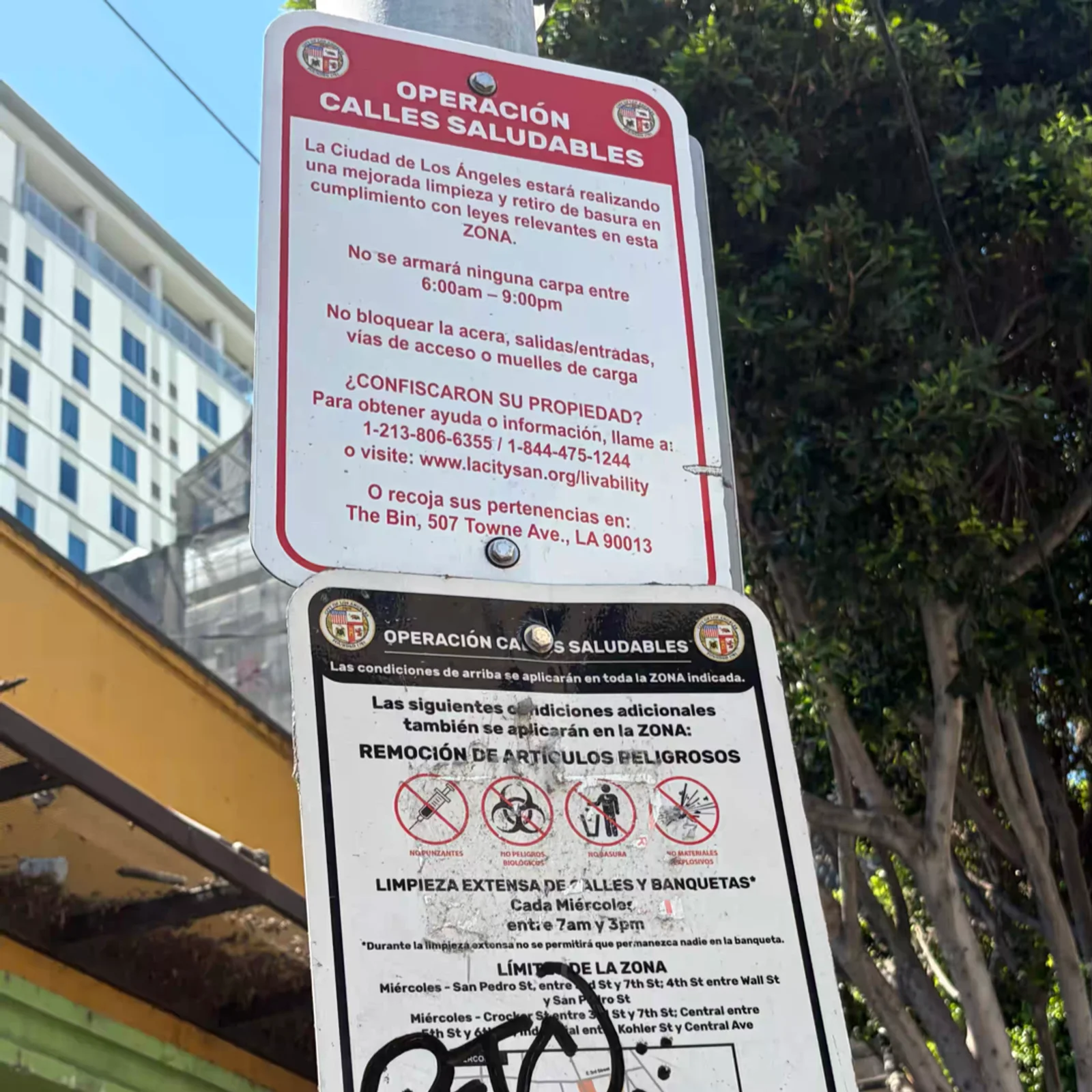
It must have been an old sign, because this street was overgrown with everything this program claimed to rid the streets of.
The following additional conditions will also apply in the ZONE:
- No sharps
- No biohazards
- No trash
- No explosive materials
It turns out Operation Healthy Streets was first implemented in 2012 to perform “maintenance of cleaned streets, including a comprehensive outreach component.” The initial budget of $1.7 million has ballooned to $4.3 million since then, with a total well over $45 million.
Are these streets “healthier”? Of course not.
And yet — for all the garbage and broken promises, Skid Row wasn’t quite as bad as I imagined: I’d been sold this idea that the whole region was a dystopian nightmare, a post-apocalyptic wasteland where human lives were exchanged for clean water or a jerry can of diesel.
There was no shortage of free food, water, and clothing being passed out by various organizations, which meant a few basic services were provided. But nothing was permanent – Skid Row’s residents were in a constant state of flux, regularly migrating from one part of the neighborhood to another, each time with a new set of personal items because the last set was stolen, thrown out, or bartered away.
***
I ambled over to San Pedro between 5th and 6th Streets, and marveled at the many tents set up by nonprofit organizations: MBI Health Services, Five Keys, California LifeLine, The People Concern, SRO Housing Corporation, Urban Alchemy, and Wesley Health Centers.
A cursory investigation revealed that, in 2025, the People Concern reported more than $117 million in revenue, Urban Alchemy reported $101 million, and Wesley Health Centers brought in around $40 million, with most or all of their executives earning six-figure salaries.
The numbers were staggering. The results, at least from where I was standing, were harder to see. It should also be noted that the three aforementioned organizations have been embroiled in controversy: The People Concern has been subject to several wrongful termination lawsuits; Urban Alchemy has faced scrutiny in multiple cities over its financial controls and shelter operations; and the Skid Row Care Campus operated by Wesley – along with two partner organizations – has drawn criticism over public safety and drug activity.
My notetaking seemed to rub one of the workers the wrong way. “Who do you work for?” shouted a wiseguy sitting under a black canopy. I pretended not to hear him and started walking away. “Yo, who do you work for?” he asked again, this time more forcefully.
“WHO DO YOU WORK FOR?!”
It seemed odd that in a neighborhood in which crime was rampant, the most confrontational interaction came from a nonprofit employee.
When I returned to San Julian, my friends were talking to a homeless woman nicknamed “Fire”; she was pregnant and had a dog with her that was also pregnant. Fire told us she was from Indiana, and that it was there that she signed up for an addiction treatment program. This “program’s” “treatment,” however, consisted of dropping her off in Skid Row with a tent.
Body brokering was one of the wilder claims that popped up during the recent mayoral election, but there it was.
“Fire” took a swig from a tall beer can wrapped in a brown paper bag. “Maybe take it easy on the booze,” I gently told her. She was, after all, carrying.
“Well, I am an alcoholic,” she said joyfully. “But I’m down to just one beer a day, so I think I’m doing alright!”
There were reports of people paying Skid Row residents to vote, which a young homeless man confirmed to us. $2-$3 was the going rate for a vote for incumbent Mayor Karen Bass or Councilwoman Nithya Raman, which we’d learn over our time in Skid Row.
A couple of paramedics we met on our second day told us that it was fairly common for homeless people to be paid to vote, though it was hard to get much useful information out of them.
And a woman we met on my third day told us that “official-looking” people often came around to pay locals a few bucks to sign petitions or ballot measures or to register for something or other.
But Fire, along with so many other homeless people in the area, was not exactly in compos mentis, which made claims of body brokering and vote-buying difficult to corroborate. Would these unreliable testimonies hold much water in a court of law?
The monsters in City Hall have spread their tendrils far and deep—and covered their tracks well. It was almost like a noir film in which the truth-telling lunatic is carted off to the asylum while the corrupt fat cats breathe a sigh of relief.
****
We returned a couple of days later. This time I went in with a bit more purpose, a bit more wisdom, and a metric fuck-ton more rage and venom. After the initial reconnaissance, I was on the hunt for something, anything, to expose the fraud and corruption that keeps Skid Row’s residents from getting the help they need.
We made our way back to San Julian. Everyone we’d met was gone, replaced by a whole new group of residents.
There we met Sean, who stuck out for his lucidity and sobriety. Sean was from New Orleans but had moved to Los Angeles to do special makeup effects in Hollywood. However, drugs and bad luck landed him on the streets, and here he was, trying to make ends meet under a tarped roof.
I asked him if street cleanings took place; he confirmed that they did, twice a month.
Of course, in true L.A. fashion, once encampments are cleared out, the homeless are immediately provided with new tents and gear.
We struck up a conversation with a couple of first responders. They’re rarely ever not responding to a call; once they drop off someone undergoing an overdose, they’re immediately heading out on another call.
We ambled along. Alongside a retaining wall, a large group of homeless people was doing drugs (there were plenty of pipes, lighters, and aluminum foil on display). We joked about calling the cops -- only to discover that the building they were standing behind was in fact the LAPD Central Community Police Station. Two men were passed out on the front steps.
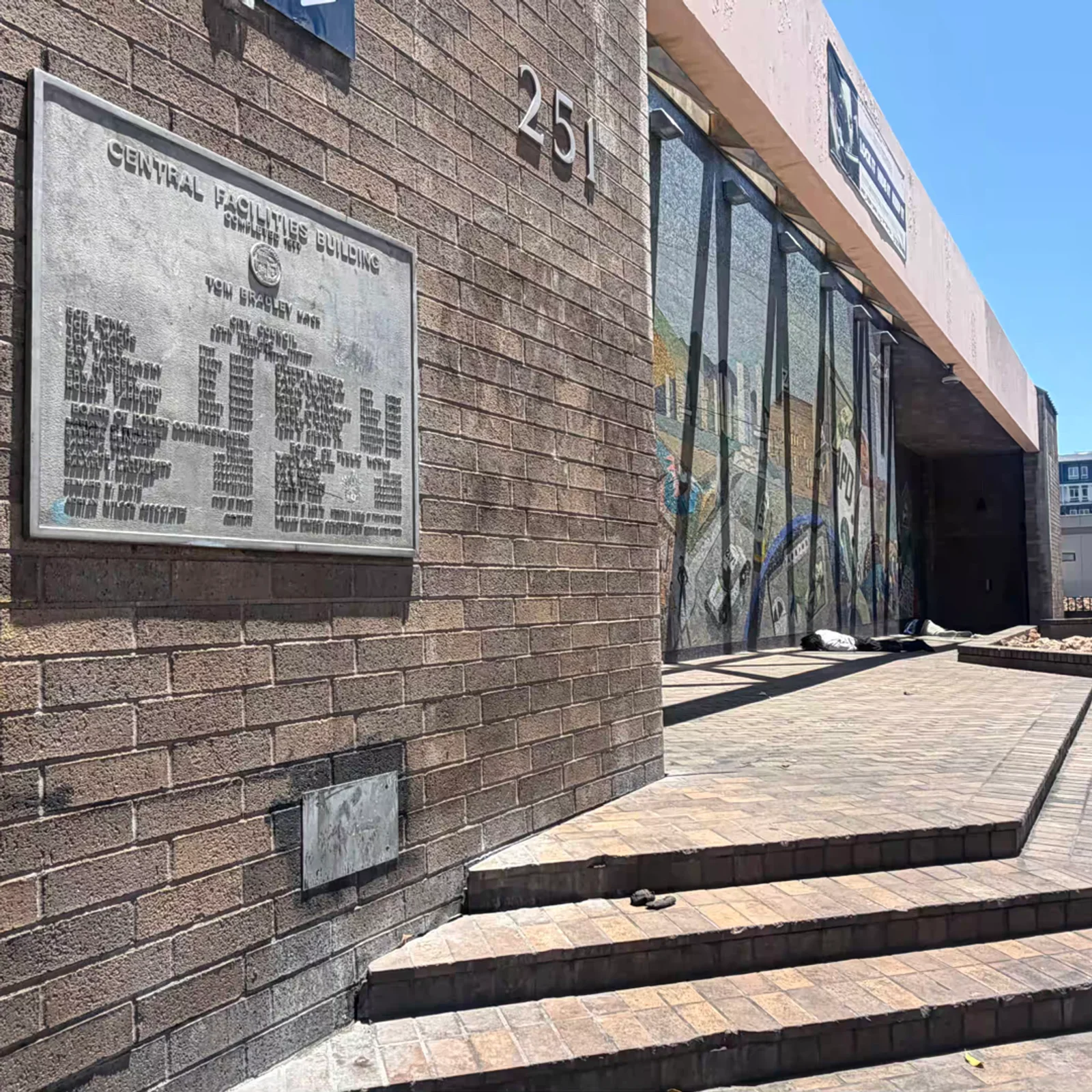
We went inside and asked the desk officer if he was aware that there was open-air drug use happening outside. He told us they would only send someone if we called the non-emergency number.
We asked why telling him face-to-face wasn’t good enough; he told us, again, to call the non-emergency number. He explained they have an enormous number of urgent calls, but that if we call the non-emergency number, they would eventually send someone to take care of it.
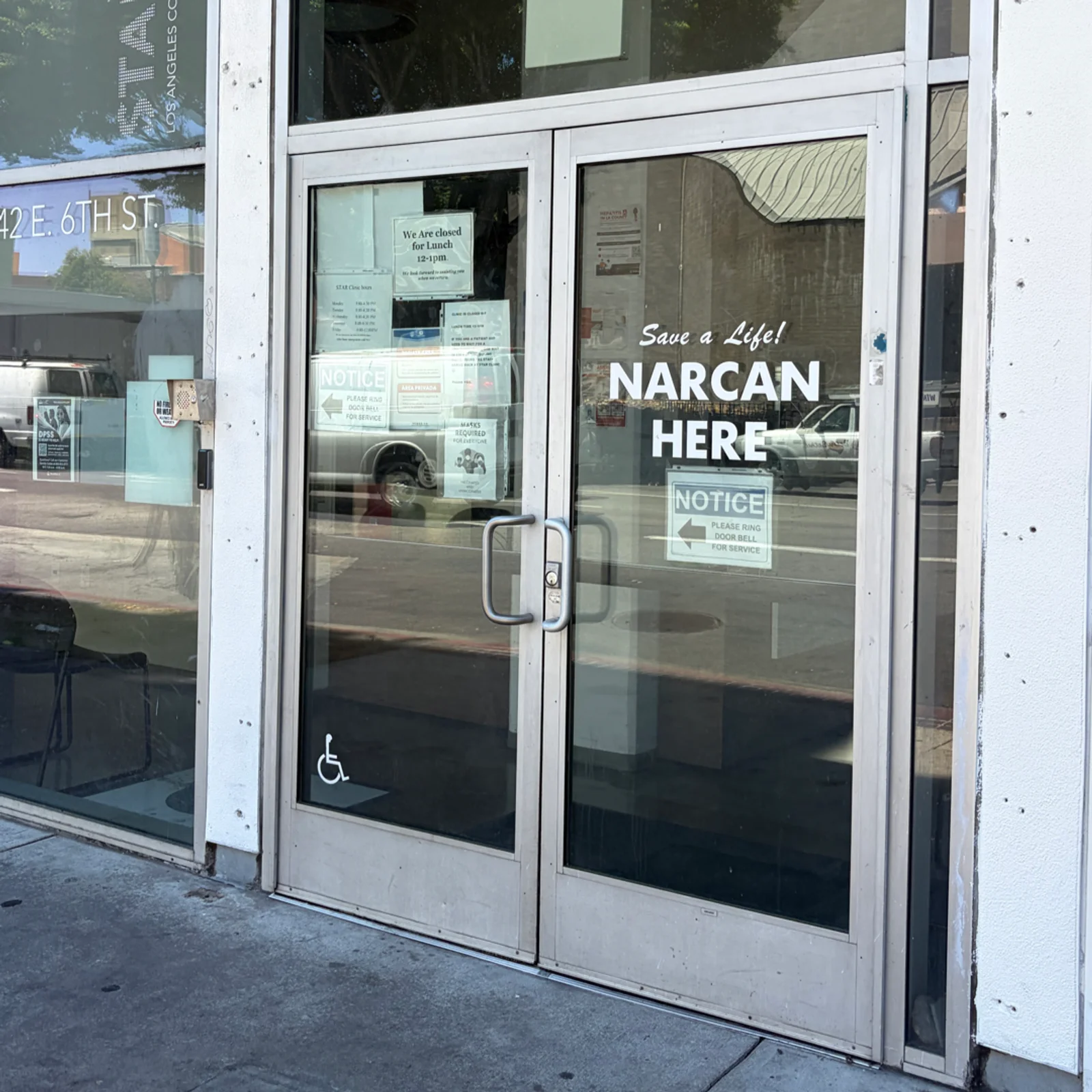
We left, confused and enraged. Across the street was the Star Clinic, advertising Narcan with the casualness of a Target spring sale promo.
We chatted with a man exiting the police precinct. He wasn’t homeless; he lived in a different neighborhood, but he drove through the area regularly to pick up his daughter who went to school nearby. We asked what he thought of the crime and degeneracy right outside the police precinct.
“It’s disgusting, man,” he told us. “This shit happens all the time, and the police do nothing. And my daughter has to see it basically every day.”
We asked who he had voted for in the recent mayoral election. “I don’t vote,” he said, before shaking his head and walking away.
“People need to vote better,” a male cop told us. “The city doesn’t let us enforce these laws. Prop 36, look it up.”
Californians voted overwhelmingly for this ballot measure in 2024, which increased the penalties for repeat drug offenders. However, in typical West Coast style, Governor Gavin Newsom did not include funding for it in the 2026-27 budget, leaving it up to counties to figure out how to pay for the growing number of drug-related incarcerations.
But if we grade the Golden State on a curve, it’s a miracle the law got passed at all.
When we asked why homeless people were allowed to do drugs right outside of the police station, the female cop gave a blank stare. The answer was obvious to everyone except for us.
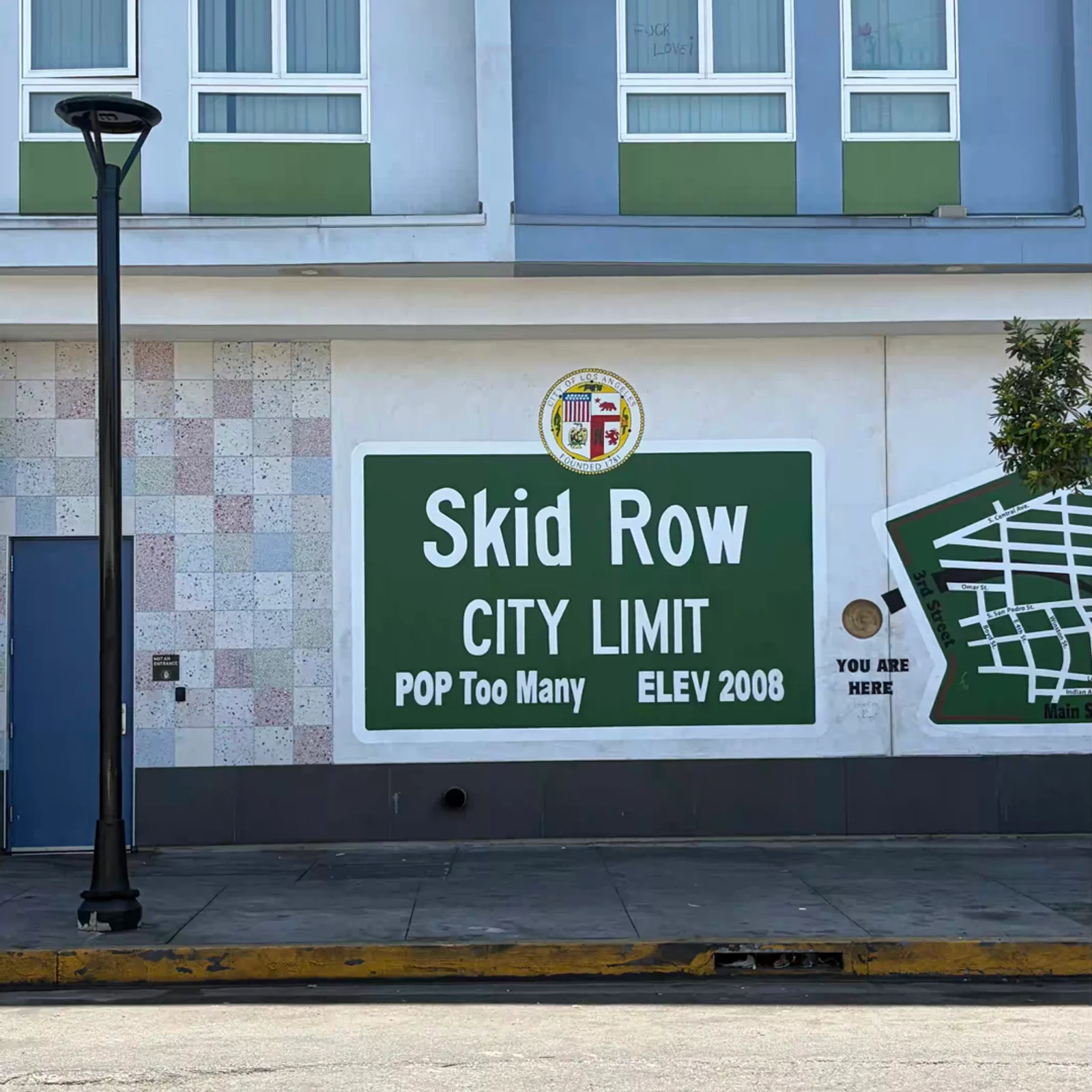
“It’s Skid Row,” she said.
—
For our third foray into the heart of darkness, Chris and I were joined by seasoned journalist and Substacker Meghan Daum, who had been introduced to us by a mutual acquaintance. I’ve long admired Meghan — her coverage of L.A’s dysfunction has been indispensable — so it was an honor to compare notes.
In her Atlantic article, “What Los Angeles Has Become,” Meghan writes, “Undeterred—and unprotected—by laws that are no longer enforced, profoundly sick humans stumble blindly into traffic, defecate in plain sight, wave machetes in the air, threaten violence to passersby, and leave dogs tied to junk-filled shopping carts while they slump on the sidewalk in a fentanyl stupor.”
Finally, someone I could talk to openly about what I believed was an interwoven and intentional endeavor to ruin L.A. “Our ‘leaders’ just seem so hellbent on maintaining the problem instead of fixing it,” I told her on the Metro ride to DTLA.
“I’d check my biases on that,” she said. “Fraud does happen here, but I think it’s mostly years of bureaucracy preventing things from actually getting done.”
Maybe it really was too easy to attribute the city’s homelessness problem to conspiracy and corruption. Things were seriously, unbelievably, insanely mishandled here, but there just wasn’t enough to chalk it all up to a vast, coordinated plan. Never attribute to malice what might just be incompetence.
But how was Skid Row still a continuing, possibly even growing problem?
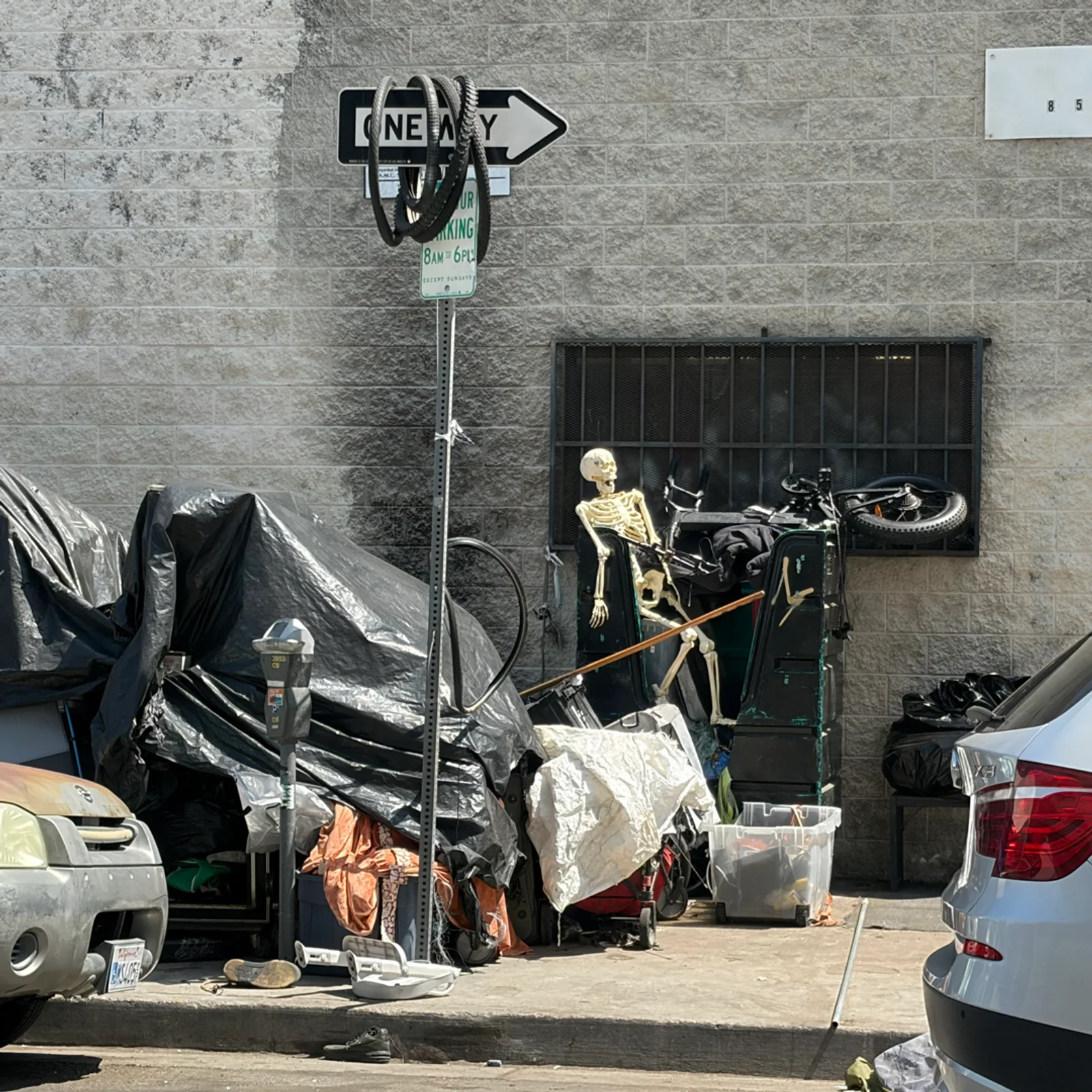
As we ambled through the streets, we saw the same things over and over: Mountains of garbage; residents plodding around, acting erratically; and towering above the fray, countless nonprofit organizations with pristine buildings.
We walked along San Julian again, handing out bottled water and interacting with locals living among the rubble and ruin.
We passed by a couple of derelicts talking to each other, standing over what looked like a dead body wrapped in a bedsheet. Should we go over and try to help? Call 911? Someone accidentally bumped into the dead body. The body moved -- it was only a sidewalk nap.
We met a homeless woman sitting on the sidewalk, brushing her hair while holding a dog. We introduced ourselves and offered the dog water, which she gladly accepted. We asked if she had a place to stay, only for her to tell us that she had been rejected. She had gone to a women’s shelter, where they told her that their showers weren’t working.
We walked over to the Midnight Mission and asked if there was a place where the woman might shower and get a room. The man at the desk explained that they didn’t offer those services, but that another place did, though they might require an I.D. There was another place that offered a room without requiring an I.D., but it was only for one night at a time.
There were so many organizations in the area, but they were impossible to navigate, even for a sane, law-abiding citizen — everyone seemed to have conflicting rules and regulations. Some required an I.D. to acquire services while others didn’t; some offered showers and bathrooms and nothing else; others offered room and board, but only if approved by a case manager, who were hard to find to begin with.
I tried to keep Meghan’s advice to manage my conspiratorial thinking, but I still couldn’t shake the idea that this was all by design — if shuttling the homeless from one organization to another in an endless cycle of rejection and low-quality assistance was all part of some demented plan. With so many of these people suffering from addiction and mental health issues, what good was the occasional meal, shower, and bed anyway? Get some food here, wash up there, crash in this part of the neighborhood for a night or two, and, if you’re lucky, score a caseworker who might set up something medium-term.
Those Operation Healthy Streets signs are more than pitch-black irony at work. They’re a perverse symbol of how L.A. leaders work: throw money at the problem, then look away and tell citizens that “these things take time.” When they get called out, just point the finger at the red tape (that they themselves created), and pass the buck one step further down the road. And the worst part is that this institutionalized apathy is contagious. Chaos has a design all its own.
On my third trip to Skid Row, I watched a homeless man stick a needle into an open wound on his leg. He did so casually, almost absentmindedly, while the city carried on around him.
“No sharps. No biohazards.”
Nobody was surprised or shocked or caught off-guard. Why would they be? In a place where sirens are the soundtrack and syringes are street litter, the extraordinary becomes ordinary.
As much as I want to believe that our elected officials are slimy, scaly monsters whose true forms are hidden by human skinsuits, the truth is almost worse. They’re regular human beings with a pulse, a bit of authority, and the unearned privilege to continue with business as usual.