What Happened at the Peptide Party?
Sex, drugs, and melanocortin receptor agonists
By Denzel Rust · October 23, 2026 · 15 min read
It was a rainy night in Chelsea, and the line went down the block. Everyone wore black, and nobody smoked cigs. As we waited for the bouncer to let us in, I noticed everyone saying it. Over and over. No one could stop. Peptide party. Peptide party. Are you here for the peptide party? This your first peptide party? How’d you hear about the peptide party? The peptide party? Yeah, the peptide party.
I approached the bouncer.
“I’m here for the peptide party.”
“Okay.”
“I’m press,” I said. “Peptide party press.”
“Right this way.”
Walking in, I felt like the subject of an experiment. I saw the logo of the party’s sponsor, afterglow, and branding materials promoting their new syringe-free products. “Modern Peptides. No Needles. No Fridge. No Nonsense.” Throughout the night, I’d be given edible pharmapseudicals that promised energy, recovery, and libido without any catch or comedown. I’d be told this was the future of hedonism. To be degenerate without degenerating. Addicted without withdrawal. To lose that special amount of control that lets you flirt and fuck without inhibition, minus the hangovers and headaches. A free lunch. To have your peptide and eat it too.
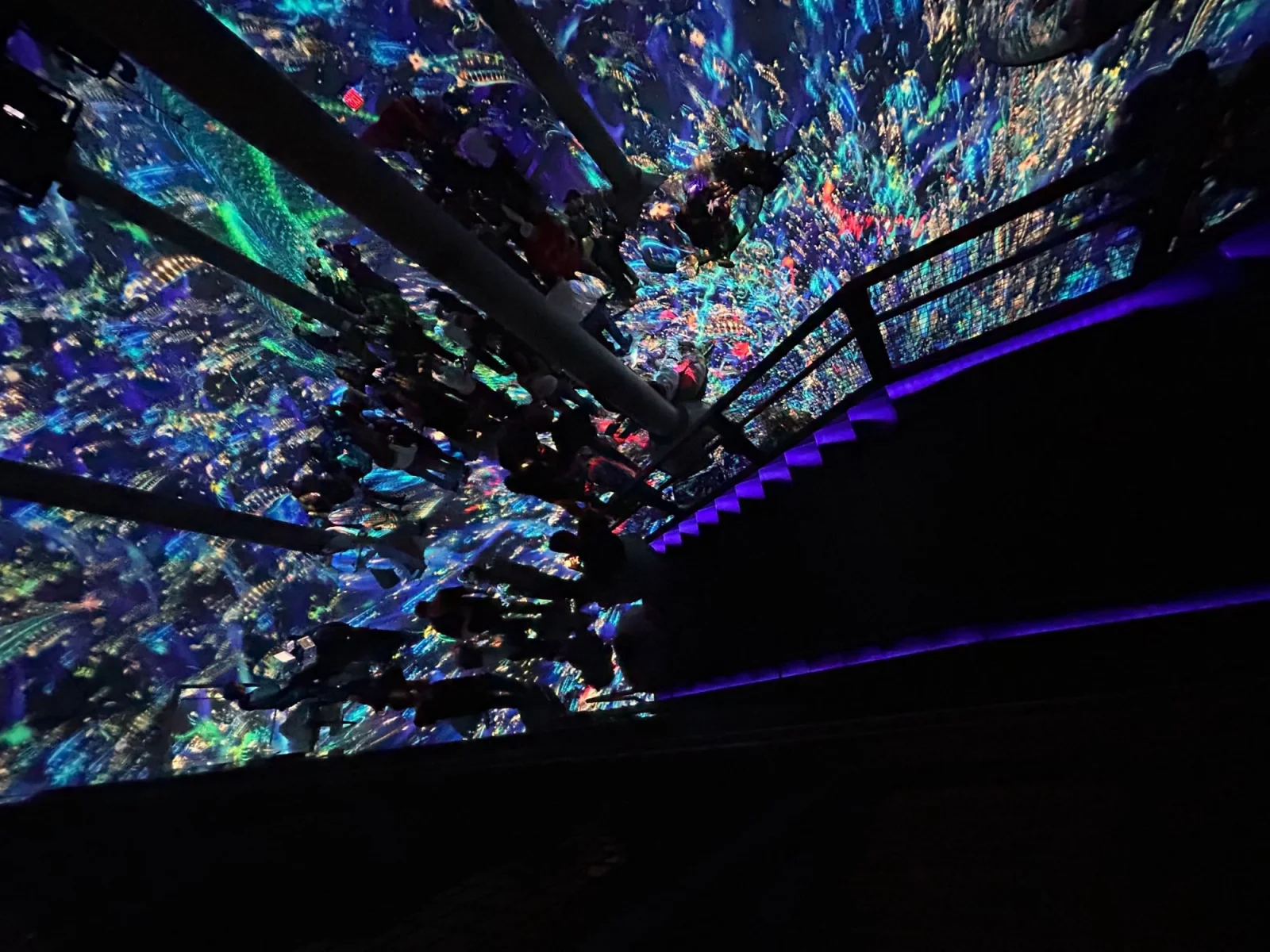
The non-press masses got blue wristbands. I got a purple one. Past the entrance was a massive industrial warehouse space with a bar on the top floor. I asked for a glass of red wine, chugged it, then asked for another one. I walked down the stairs and into the vast blank canvas, projected upon with psychedelic visuals of primordial organisms. I felt like I was in a Gaspar Noé movie about the Cambrian explosion. Scales and spirals and vertebrates pulsating with neon electricity. Sleek, smooth black pillars jutted up toward the ceiling. In the center of the dance floor, standing perfectly still, was an ancient galactic warrior.
“Hello,” I said. “Welcome to the peptide party.”
He nodded.
“You work here?” I asked.
“Admit nothing. Deny everything,” he responded.
“Hmm. Okay. Is this your first peptide party?”
“Admit nothing. Deny everything,” he repeated.
“Right. Hmm. Is your sword real?”
“Admit nothing, deny—”
“—Everything,” I interrupted him. “Right. Can you at least tell me your name?”
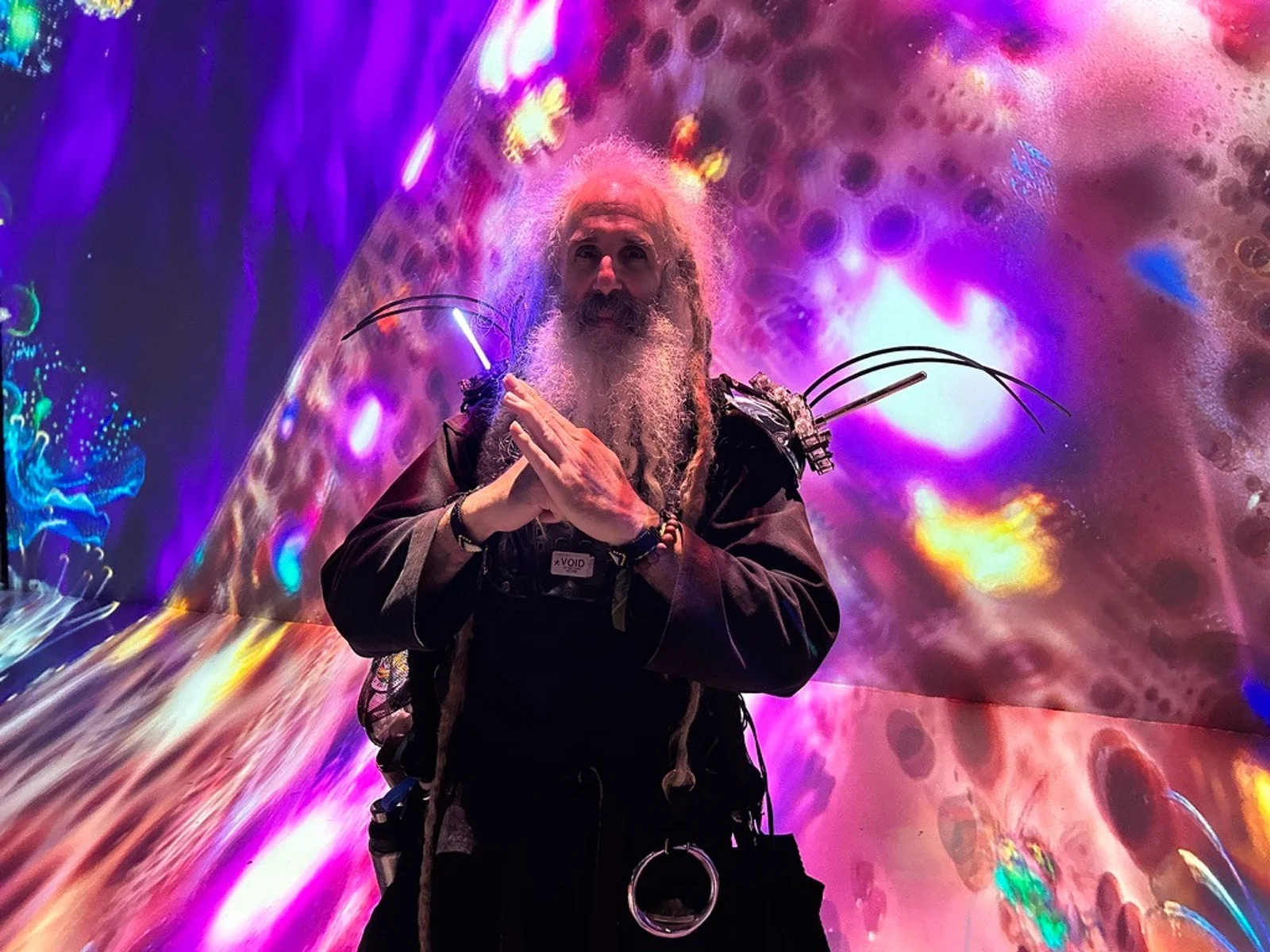
“My name… is Cyborg. But my daughter calls me Papa Cyborg.”
“Nice. You from around here?”
“I am from where we are all from,” he says. “From within your heart.”
“Wow,” I say. “Do you take any peptides?”
“Admit nothing, deny everything.”
Fuck that guy.
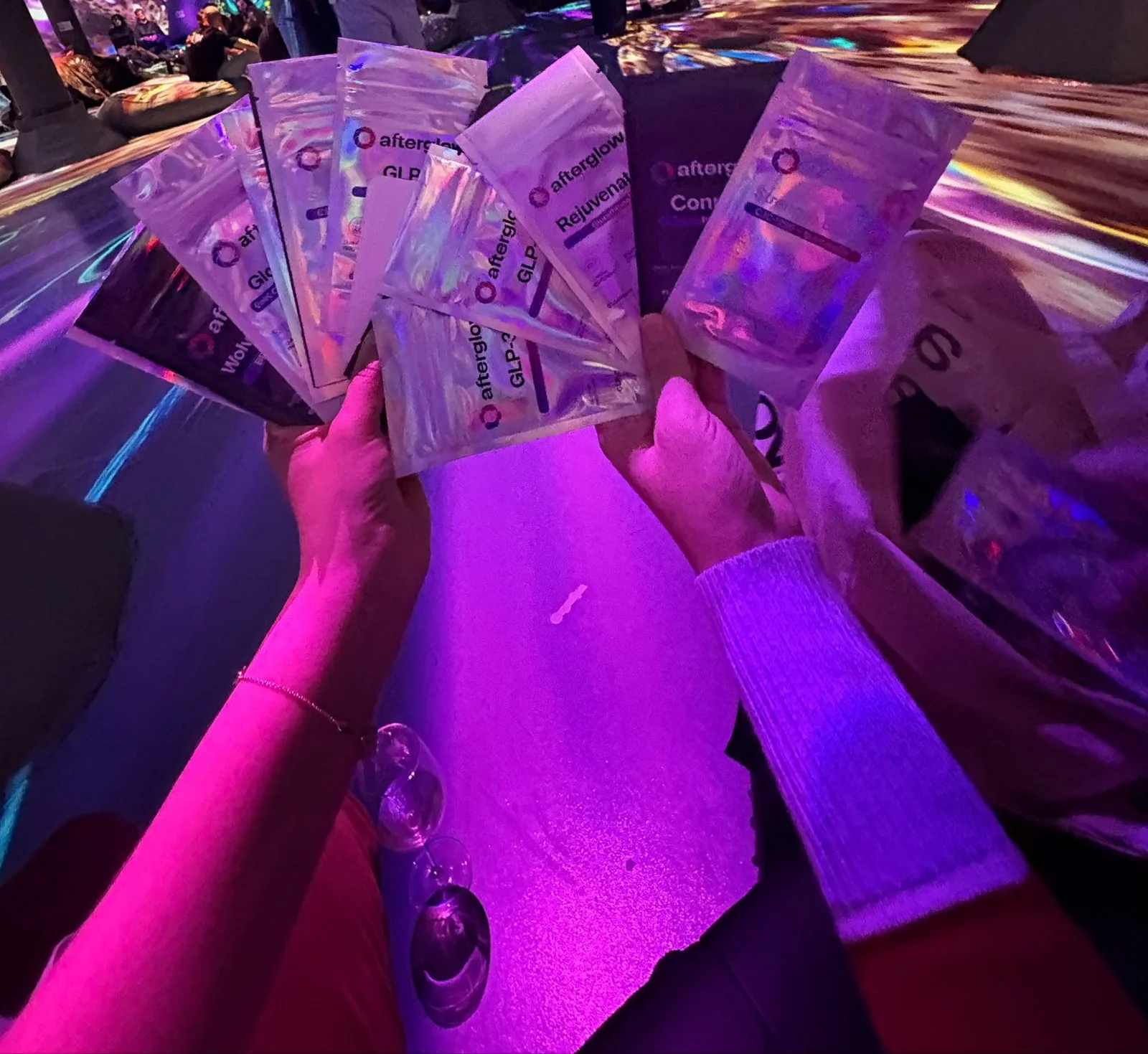
Sick of Cyborg’s bullshit, I wandered into a small side room where the staff were handing out peptide gift bags. The kid working the booth told me that because of my purple wristband, I got a VIP bag of every orally ingestible peptide afterglow has to offer. There’s “GLP-2” and “GLP-3,” AKA Tirzepatide and Retatrutide. There’s “Rejuvenate,” which contains glutathione for oxidative stress. There’s the “Wolverine Blend,” which is similar to “Glow Blend” and improves your skin, hair, and tissue quality. There’s “Charge,” which the kid likens to coffee but for your “cells,” and finally, there’s “Connect,” AKA PT-141, the sex peptide, which promises “Deeper Bonding” and to “Ignite the Spark.” Ooh la la.
“What’s your favorite?” I asked the kid.
“Charge,” he said. “But you’ll be up all night.”
“Perfect,” I responded.
“Just place the tab under your tongue and it’ll dissolve.”
“Like thith?” I asked with a lisp.
“Like that,” he said.
I examined the accompanying literature. Each peptide came in a resealable plastic packages and looked like a colorless translucent breathstrip. “Charge,” the energy peptide, “Rejuvenate,” the oxidative stress peptide, and “Connect,” the sex peptide, had effects that lasted hours rather than days. The GLP-2 and GLP-3 weight loss peptides had a half-life of about a week, equivalent to their injectable alternatives. They all dissolved under the tongue in minutes and tasted like peppermint.
I collected my tote bag and walked back to the dance floor fully charged. There I met Jeff and Greg Dalli, the brothers who co-founded afterglow and were eager to tell me about its mission. Greg lost his sight when he was six years old and, years later, began looking into peptides for a possible cure. He encountered more immediate obstacles: vials, hard-to-measure dosages, expiration dates, and, of course, needles.
“I kind of set out to solve the problem for me,” he explained. “Now ten percent of our profits go toward research.”
“Are peptides a subculture?” I asked them. “Do you want them to be?”
“I think in the long term we expect peptides to be so ubiquitous that it doesn’t feel edgy or interesting to be someone who uses them or experiences them,” Jeff explained. “But in the stage that we’re in now, it is a cultural niche, something that people whisper to their friends about.”
Was this the inverse of a subculture? Or its purest form? Punks, beatniks, Marxists, hippies, skaters, goths, define themselves by exclusion. But here was a subculture that was genuinely small, selective, and unique, with the audacity to anticipate ubiquity.

I approached a pair of tech guys by the DJ booth.
“What are you most insecure about?” I asked a chubby Asian dude.
“What am I most insecure about?”
“Yeah, like if you could have a peptide that fixed anything about yourself, what would you choose?”
“Weight loss,” he answered. “But I’m afraid GLPs will lower my chi.”
“Because GLPs blunt your desires?”
“Yes.”
“We need a chi peptide, huh?”
“Definitely.”
What the architects of the peptide party envisioned was a world where you eat but don’t get fat, age without getting old, and escape yourself without going anywhere you shouldn’t be. There was something ugly in that.
I liked this question, so I kept asking it. An Indian guy with an obvious toupee told me he wanted a peptide that could regrow hair. A girl with a zit on the side of her cheek told me she’s excited about the one that improves collagen levels in her skin. For an eclectic group of neo-reactionaries and post-left transcendentalists, the vanities they grappled with were relatively mundane. Nobody danced, but everyone talked. After grabbing my third glass of wine, I bumped into Birb.
Birb, AKA Tori, AKA Chairman Birb Bernanke, planned the event. She has blue-dyed hair but told me that the only people who don’t come to these things are risk-averse leftists. She’s the CEO and founder of Soup, an experiential marketing firm that describes itself as a “social lab.” She met her husband on X and moved in with him on their first date. I noticed, while looking into her eyes, a contact lens that made her look part android.
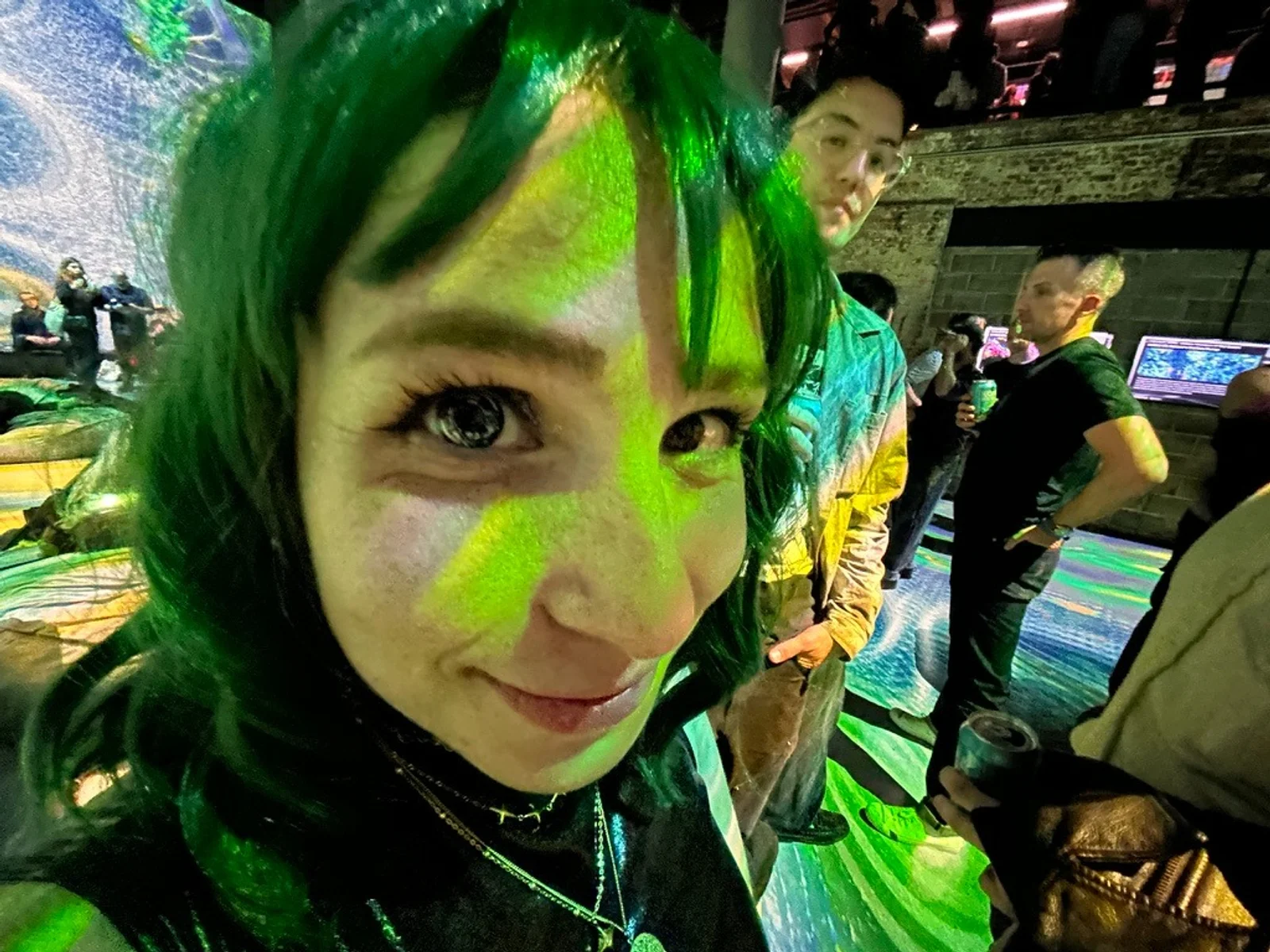
“We’re five to fifteen years away from being able to shapeshift,” she yelled over the music. “These peptides are just the first step.”
I interrogated her for information on the peptide party people.
“Have you heard that joke people make that’s like, if you took XYZ, you don’t need to worry what’s in the COVID vaccine?” She asked. “It’s the same ideology here. People who are into risk-taking. When you’re biohacking, you’re kind of taking your body into your own hands and deciding that you’re gonna experiment with it. You don’t need the institutions or the credentialism that comes with, like, being a doctor. Taking control of your body is extremely punk rock.”
I noticed Cyborg lying on a nearby bean bag.
“Does that guy work here?” I asked.
“No,” Birb responded. “He came up to the entrance, said, ‘I am a citizen of planet Earth,’ and walked in.”
This wasn’t Birb’s first peptide party. The first, a “Chinese Peptide Rave,” was thrown in San Francisco last year. The second, a “Peptide Soirée,” took place during New York Tech Week, was Prohibition-themed, and apparently had a lot more people making out. She believes first and foremost that a good party requires “plausible deniability,” i.e., an explicit reason for people to talk to each other. A thing someone trying to fuck can use as an excuse to approach a total stranger.
“If you build the right container, people will come,” she explained. “In both senses of the word.”

This inspired me to go outside and have a cig, hoping I might find someone to share my “Connect” sex peptide with. No dice. Zero smokers. A group of East Asians calling an Uber and two vaping security guards. At most parties I go to, the people I actually want to talk to are all outside smoking. Because smoking is disgusting and bad for you and borderline socially repulsive, it selects for people who are gross, wish they were dead, and want to piss people off. The inverse of the peptide party people.
A girl recognized me on her way out. Within a few minutes of intros she told me she was off to meet her married polyamorous boyfriend.
“His wife had a miscarriage a few weeks ago,” she said. “So he’s been dealing with that.”
I asked how they met, and she said “SlutCon,” Aella’s sex education conference that took place in September. From there, she pulled out her phone and showed me an app called Glosso, also made by Aella, which tracks its users’ sexual partners in a large multivariate matrix of data points known as the “Slutcloud.”
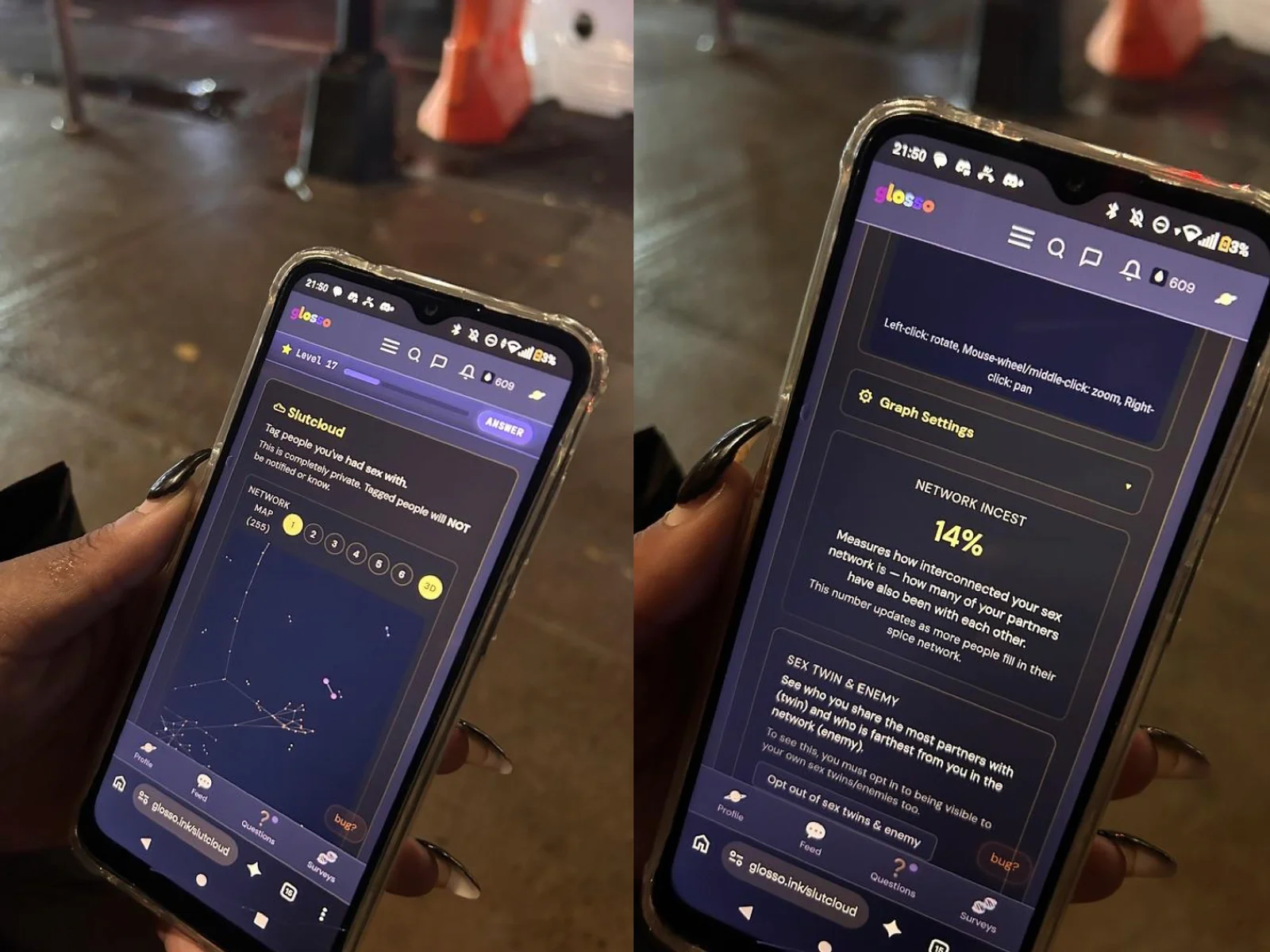
Additional features of the Glosso app include the “Network Incest” calculator, which “Measures how interconnected your sex network is—how many of your partners have also been with each other,” and the “Sex Twin and Enemy” feature, which allows you to “See who you share the most partners with (twin) and who is farthest from you in the network (enemy).” Not my jam, but it seemed like the logical endpoint of Birb’s “plausible deniability” theory. A procedural excuse for sex nerds to approach, engage, and eventually become immortalized in each other's Slutclouds.
“So I’m an Aella two,” she explained.
“Wait, what’s an Aella two?”
“An Aella two is someone who has had sex with someone who has had sex with Aella. An Aella one is someone who’s had sex with Aella herself. An Aella three would be someone who has had sex with someone who has had sex with someone who has had sex with Aella.”
“So the fluffer would be an Aella two?” I ask. “And anyone who cums in the fluffer would be an automatic Aella three?”
“Exactly!” she said, like she’d just taught me how to do long division.

I made my way back inside the now-packed party. More than 400 people showed up. I asked for a fourth glass of wine, chugged it, asked for a fifth, then noticed Birb nearby.
“Are all these drinks on you?”
“Yup,” she said. “Add it to my $12,000 tab.”
We started talking about parties again, and Gen Z, and why they seem to be so content with sobriety.
“I think it’s multivariate, but yeah, alcohol is expensive. Everything’s expensive. Young people can barely afford to leave their houses in the first place, and now you want them to go to a bar where it’s $25 a drink? And for what? For them to feel like shit the next day? And so as everyone’s trending towards optimization and looksmaxxing, everyone kind of forgets how to have, like, fun. But, you know, I think alcohol is maybe a social lubricant on purpose. And so I think it’d be a real shame if it fell totally out of favor,” she explained. “Which just means we need better hangover cures.”
I was on board with the drink prices being too damn high, but unconvinced by the promise of “better hangover cures.” Here again, I was being promised sin without repentance. And would I really want to eliminate hangovers if I could? Were they uniformly bad? Or was there a groggy pleasure in waking up with ringing ears, a dryly agape mouth, and a few mysterious gaps in recollection? To be debilitated by your own behavior and write off an entire day, rather than waking up refreshed and immediately starting to vibecode.
I walked downstairs, sat on a bench, and took more peptides. I combined “Rejuvenate” with “Strength Blend.” Then a girl in a red dress sat down to my right.
“Where’d you get those?” she asked, pointing to the peptides.
“Ower thewe,” I lisped. “Buh I’m fee-aye-pee.”
“VIP?” she asked.
“Yah.”
After the tabs had sufficiently dissolved, I explained that I was writing an article on the event. I don’t usually do this because it puts people on guard, but I felt some urge to be honest with her from the jump, or maybe just thought she would sleep with me. Eventually, I asked what she was most insecure about, what magical peptide she would wish into existence. She said something for her hair, that it was thinning, and that thinning hair was actually a really difficult problem for women to solve. She told me she’d joined various online communities where women tried experimental solutions, but nothing had really worked. She seemed to be hoping I’d spread the word.
Then, out of the corner of my eye, I noticed a pair of strange lumps on her hand. She noticed me noticing them, even though I had looked away quickly. She held out her hand and bent back her thumb.
“Were you looking at this?” she asked.
“Yeah.”
“It’s a microchip,” she explained. “I got it at a tech party in Vegas. It’s FDA approved for dogs and cats, but not humans.”
“What does it do?”
“Give me your phone.”
I pulled out my phone. She grabbed it from me and held it up to the microchip sticking out of her hand. A notification popped up on the screen.
“Swipe it,” she said.
I did. I swiped it. And before I knew it, the music video for “Never Gonna Give You Up” by Rick Astley was playing. I stared at her in total disbelief.
“My gay friend dared me to get it,” she explained.
I went to take a piss. Someone's been jacked off with that hand, I thought. Someone’s been jacked off by a hand that had a Rick Astley linked microchip inside it. I looked in the bathroom mirror and noticed vampiric wine stains on my teeth and tongue. You drink wine, you get wine stains. You do shots, you get a hangover. You smoke, you darken your lungs. You rail lines, you damage your cartilage. You live, you die. What the architects of the peptide party envisioned was a world where you eat but don’t get fat, age without getting old, and escape yourself without going anywhere you shouldn’t be. There was something ugly in that.
I grabbed one last glass of wine and went back downstairs. I gave my skin peptide to a skinny actress who does Gasda plays. She was “fresh out of a relationship” and also had no desire to “Connect” with me. After lounging for a while on the beanbag chairs and watching the party start to peter out, I headed to the entrance for a final cig.
A blonde I had noticed earlier was smoking too.
“This your first peptide party?” I asked.
“Yup, how about you?” she responded.
Birb’s plausible deniability theory vindicated once again. A perfect excuse to bother her. We talked about her exes. We talked about the sexlessness of the tech scene. We talked about the people we knew there, of which luckily there were none. I told her about the article I was writing, about its developing angle; that it was about the inherent value of a hangover and the hidden virtues of true degeneracy, or maybe it was actually about how the more technology changed the more our desires remained the same. She seemed vaguely into me. I seemed vaguely into her. About half an hour later I was groping her in the back of an uber.
“Not to be presumptuous, but do you want to take these sex peptides?”
“What? I didn’t get sex peptides.”
“They were VIP only.”
“Yeah, gimme one.”
I opened the “Connect” pack and handed her one of the vacuum-sealed silver packets. I explained that you put the tab under your tongue and it dissolves after a few seconds. There was the slight implication that we were peers in a control group.
“Wah do theeth do ethacly?” She asked.
“Dtheeper bhond. Ignithe the sphark,” I read off the label.
“Coulden we jush thake molly for thath?” she asked.
“Ya I gueth.”
Does something work if you can’t tell it’s working? Weed or acid alters your mind, but something that makes you awake, satisfied, or aroused just feels like “you.” Peptides are body highs in the truest sense; you don’t even notice them, so parsing your natural vs. artificial desire is almost impossible mid-thrust.
“You can totally stay over,” I said, rolling out of bed and looking for a towel.
“Oh cool.”
I tossed it to her. She wiped herself off. I got a glass of water and we lay distinctly side-by-side.
It was only afterward that the creepy implications of “Connect” became clear. It had worn off, revealing a disparity between how hard I’d cum and how much I wanted her to stay over. A neutral control group against which I could confidently but regretfully endorse afterglow’s revolutionary new product.
“Actually, sorry, I don’t think I’ll be able to sleep that well if you stay over. I’m just a really particular sleeper.”
“Oh.”
“Do you mind if I call you an uber?”
“No, that's fine.”