The Convenient Target
John Galliano and the Hypocrisy of Left-Wing Jews
By Adam Lehrer · September 12, 2026 · 12 min read
New York City Council Speaker Julie Menin, the Jewish daughter and granddaughter of Holocaust survivors, has been predictably restrained in her criticism of Mayor Zohran Mamdani. Although sold as the “moderate” Democratic check on the radical left-wing and Islamist currents that have found their most successful vessel in Mamdani, Menin has largely ceded the mantle of mayoral antagonist and settled for the role of tactful dissenter.
This restraint has survived an extraordinary accumulation of provocations, like associations with the Council on American-Islamic Relations (who were named unindicted co-conspirators in the Holy Land Foundation Hamas-financing case, and have featured Linda Sarsour as a speaker). Yet Menin’s rhetoric toward Mamdani remains almost cautious. Given this treatment, one might expect her to extend a similar degree of grace to the iconic fashion designer John Galliano, whose planned retrospective at the Metropolitan Museum of Art was canceled last week over the drunken antisemitic and racist tirade caught on video more than 15 years ago, despite Galliano’s subsequent apologies, rehabilitation efforts, and visit to Auschwitz. Menin, however, helped lead the campaign against the exhibition.
On Aug. 28, Menin wrote to Met CEO Max Hollein, Costume Institute curator Andrew Bolton, and Vogue editor Anna Wintour, who is Jewish but has apparently had this fact scraped from the internet, demanding that the museum relent to pressure from its Jewish donors and cancel the Galliano retrospective altogether:
“Words matter, and whom we choose to elevate is a direct statement of our values and what we are willing to tolerate. Galliano’s long public record of antisemitism, racism and anti-Asian bigotry is deeply troubling. At a time when our city is confronting a serious rise in antisemitism, anti-Asian hate, and other forms of hatred, I find the decision to so prominently honor someone who has engaged in this behavior to be wholly inappropriate.”
Given the ferocity of her campaign, and that of the Met’s other critics, it is worth recalling precisely what Galliano did to remain persona non grata 15 years later. In 2011, Galliano was shitfaced at La Perle, a Paris café, belligerently haranguing another patron. Apparently deciding that the woman looked Jewish, he declared, “I love Hitler.” He also called the woman’s South Asian dinner companion a “fucking asian bastard,” hence Menin’s reference to the designer’s alleged “anti-Asian bigotry”.
“People like you would be dead today,” Galliano continued with his trademark homosexual aplomb. “Your mothers, your forefathers would all be fucking gassed and fucking dead.”
Dior, where Galliano had served as creative director since 1996, fired him immediately after the video surfaced. Considering that Galliano had reportedly quadrupled the house’s ready-to-wear sales during his tenure, the move was seismic. That September, a French court found him guilty on two counts of making public insults based on origin, religion, race, or ethnicity. Galliano’s reputation was further tarred when respected art curator Géraldine Bloch testified that he had accosted her at the same restaurant a year before the filmed incident. According to Bloch, Galliano pulled her hair and subjected her to a torrent of antisemitic abuse, including “dirty Jewish face,” “fucking ugly Jewish bitch,” and “sale juive, tu devrais être morte,” meaning “Dirty Jew, you should be dead.” Bloch isn’t Jewish.
In the aftermath of the scandal, Galliano apologized profusely and insisted that he held no deep antisemitic beliefs. He attributed his behavior to extreme stress, alcoholism, and drug addiction.
Kevin Macdonald’s 2024 documentary about Galliano, High & Low, captures the extraordinary pressure surrounding his crash-out. Between Dior and his namesake label, Galliano was responsible for as many as 32 collections a year. For a while, the workload suited him: Galliano’s ideas arrived at a manic rate. Eventually, however, the schedule consumed him. Cocaine and alcohol propelled him through the work before the inevitable comedown arrived in a fog of sleeping pills, benzodiazepines, and opiates. He was also effectively starving himself to remain as thin as the clothes-hanger models walking his runways. Nevertheless, Galliano attempted to make amends with the Jewish community, meeting with rabbis and political leaders before being allowed, with considerable hesitation, back into the fashion industry. In 2014, he was appointed creative director of Maison Margiela, the namesake label of Belgian designer Martin Margiela. Few positions could have been more difficult to fill. Galliano was not only the first designer asked to succeed an avant-garde titan at his own house; Maison Margiela’s identity depended largely on the enigmatic, spectral presence of its founder. Margiela never showed his face to the press, rarely explained his creative decisions, and infused the brand with a bewildering aura of anonymity and mystery. Galliano stepped into a house haunted by the ghost of its creator.
The left-wing antisemite is therefore ‘concerning,’ while the right-wing antisemite is an existential threat that must be smited—even when he is not a politician at all.
He lasted roughly a decade at Maison Margiela, infusing the house with his own romantic and deeply elegant sensibility while remaining respectful of Margiela’s established identity. And yet, after all that, Galliano now finds himself back in the same hot seat he occupied 15 years ago, for exactly the same offense. Perhaps lacking the energy for another public lambasting, he posted the following statement to Instagram last week explaining his decision to withdraw from the Met:
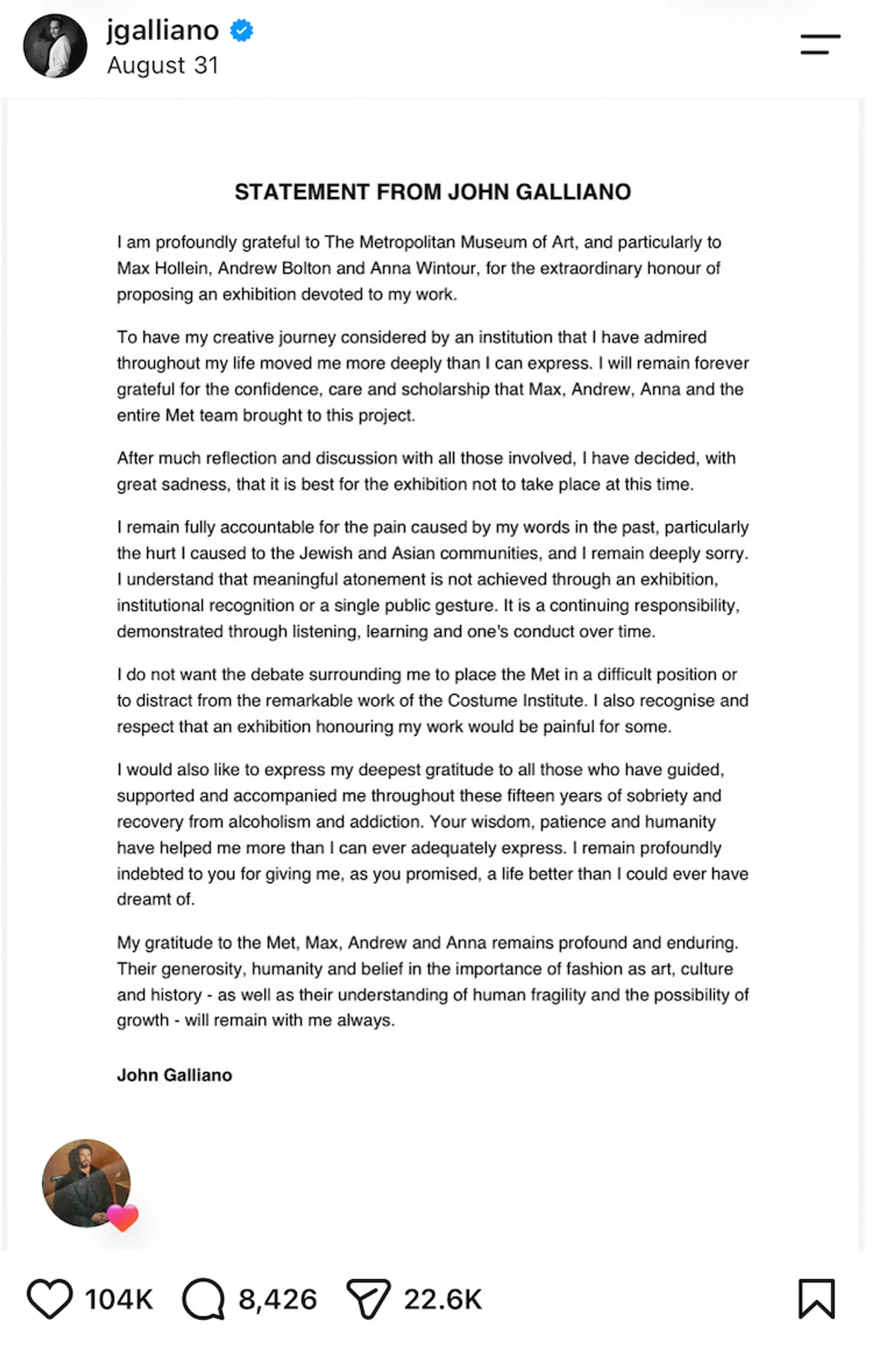
It’s worth identifying the particular Jews who led the cancellation campaign and noting the glaring trait they share beyond their semitic religious backgrounds:
- New York City Council Speaker Julie Menin
- Progressive Democrat and congressional candidate Brad Lander
- Progressive Democrat Senate candidate Micha Lascher
- Pace Gallery CEO and Democratic donor Arne Glimcher
- Elie Wiesel’s daughter and liberal Democrat Elisha Weisel
In a word, elite libtard Jews.
What’s ironic about the situation is that denying Galliano’s platform due to allegations of antisemitism is fundamentally a repudiation of Jewish ethics. To reject the work because of the man is to treat art as a sacrament of the artist’s soul. Judaism offers another framework: The work is melakhah, skilled labor performed in the world. It can be judged, used, argued with, and even loved without deifying the person who made it. In other words, the Jews pioneered the whole fucking concept of separating the art from the artist.
French literary critic and Holocaust refugee George Steiner maintained a famously complicated reverence for the poetry of the antisemite T. S. Eliot. Unlike critics who tried to decouple Eliot’s antisemitism from his art, Steiner observed that “Eliot’s uglier touches tend to occur at the heart of very good poetry.” Whereas Ezra Pound’s antisemitism struck him as vulgar and slapped onto the work like graffiti, Eliot’s prejudices were elegantly woven into the aesthetic fabric of his masterpieces. In a display of radical Jewish intellectualism, Steiner argued not only for engaging with Eliot but for confronting the possibility that antisemitism was among the forces animating his art. Later, many Jews wanted Louis-Ferdinand Céline expelled from the Western canon over his virulent antisemitism and wartime association with Nazi collaborationism. America’s great Jewish literary godhead Philip Roth was not among them. Roth bristled at attempts to diminish the immense prosaic beauty of Céline’s masterpiece, Journey to the End of the Night, on account of the ugliness of the man who wrote it.
Throughout history, the recurring Jewish temptation toward overreaction and censorship has been checked by intellectuals like these, who insisted on appreciating and finding spiritual value in art despite any perceived moral ugliness surrounding its creator. This is Judaism at its most confident: an unwillingness to confuse aesthetic judgment with spiritual endorsement. Applied to Galliano, that tradition should make the conclusion easy. His art remains worthy of celebration despite his cocaine-soaked chimp out.
Outside a rarefied handful of designers—Martin Margiela, Alexander McQueen, Miuccia Prada, Raf Simons, and perhaps a few others—hardly anyone has done more to push fashion forward. Across more than a decade at Dior and roughly another at Maison Margiela, Galliano transformed the industry several times over. Sheridan Martin, a tutor at London’s Central Saint Martins, told NPR in 2010 that Galliano’s work was so modern that nothing else resembled it. “It was genius,” she said. “And you have to respect genius.”
Galliano’s “genius” is generally attributed to innovations in fashion storytelling. He was among the first to treat every runway show as a self-contained narrative universe rooted in deep references to both historical conceptions of luxury and contemporary sub-cultures. Galliano treated every runway as a cinematic spectacle designed not to just make a splash in the media but also to illustrate the story or theme of those collections. His 1984 Central Saint Martins graduate collection “Les Incroyables,” for instance, referenced the fashion worn by the late 18th Century subculture of the show’s title—translating into English as “the Incredibles”—and the way they dressed after the fall of Robespierre. The models’ deliberately weathered and crinkled jackets and disheveled hair styles positioned Les Incroyables as, essentially, the punk rockers of France post-Revolution. The show was so admired that the London boutique Brown’s bought the entire collection—an extremely rare feat for a student designer—and immediately catapulted Galliano’s namesake line into the market and paved the path for him to eventually be hired at the legacy fashion houses Givenchy, Dior and Margiela.
Between his aforementioned penchant for historically evocative ideas, in addition to his well-documented skill for rigorous and detail oriented hands-on craftsmanship, Galliano became one of the most critically acclaimed and commercially successful designers of his generation. On the levels of bonafide talent and cultural importance, Galliano’s legacy is close to undisputed.
But liberal Jews were having none of it. And this, I believe, is why:
The most relevant philosophical framework for this conundrum is Kenneth Burke’s “scapegoat mechanism.” In works such as Permanence and Change and A Grammar of Motives, the 20th-century literary theorist argued that, rather than undertake the painful work of introspection or repair broken systems, leaders and communities use rhetoric to transfer their guilt onto a convenient target. By concentrating their failures in the figure of a scapegoat and symbolically expelling it, the group experiences purification and rebirth without changing its behavior, surrendering its beliefs, or disturbing the status quo.
It’s pretty fucking easy to see how this directly relates to the contradiction of being a libtard Jew in 2026. A recent poll by Brookings found that a staggering 44% of Democrat voters now believe that Israel is an illegitimate, apartheid state. Extremist left-wing and anti-Zionist political leaders are quickly becoming the most visible politicians in the Democratic party, from Mamdani to Michigan Senate candidate Abul El-Sayed—whose mother, it was recently reported, worked for Islamic American Relief Agency at the end of the ‘90s when that group was prosecuted for financing Osama Bin-Laden’s terrorism and has been accused of sympathizing with the Muslim Brotherhood—to several congressional candidates in New York who all share the belief that Israel’s war on Hamas amounts to a genocide.
Menin, Lander and the rest, however, feign less concern about their party being taken over by Islamic extremists than they do an alcoholic fag and brilliant fashion designer having an antisemitic meltdown 15 years ago? That doesn’t sound right to me, and I believe their cancellation of Galliano is little more than a cope; utilizing Galliano’s explosively controversial reputation, they get to momentarily distract (or scapegoat, as Burke would say) from the fact that a more sinister and politically organized form of antisemitism in their own party has bubbled closer to the surface for years.
It’s not like we don’t have precedent for this either. After October 7, Antifa and other left-wing activists immediately responding to the rape and butchering of thousands of Israelis with protest against Israel’s status as a “settler colonialist” project, liberal Jewish politicians seemed much more concerned about Kanye West’s two year long foray into performative right-wing antisemitism that culminated with his 2025 single “Nigga Heil Hitler.”
While it’s perfectly plausible that both Galliano and West do harbor antisemitic beliefs—after all, fashion designers have to work with a lot of Jewish money men—but are the private pathologies of two brilliant artists really more disturbing than an organized anti-Zionist bloc taking center stage within liberal Jews’ own political party? Thus, Galliano’s cancellation fulfills a dual purpose for the libtard Jew. It allows her to advertise her opposition to antisemitism and loyalty to her people without threatening the party structure to which she has pledged allegiance. The left-wing antisemite is therefore “concerning,” while the right-wing antisemite is an existential threat that must be smited—even when he is not a politician at all. By sacrificing Galliano, liberal Jews can perform resistance to antisemitism without confronting the form of it accumulating political power in their own coalition.
The same cultural machine that cannot tolerate a 15-year-old video of a shitfaced designer has spent years platforming, tenuring, and inviting to galas people who traffic in odious left-wing antisemitism: “globalize the intifada,” Holocaust inversion, campus encampments, and the casual transformation of Jews into settler-Nazis. Galliano’s cancellation should not be blamed on Jews as a people. It belongs to a particular liberal Jewish establishment whose politics rest atop a mountain of hypocrisies and contradictions. Its refusal to recognize Galliano’s rehabilitation disguises its cowardly tolerance of movements openly committed to diminishing Jewish security and political power.
When elite Jewish libtards make a spectacle of punishing an artist while accommodating politically useful antisemites, they degrade the Jewish values they claim to defend. That is not who we are, and these people should not be permitted to represent us. Furthermore, we’re decades into cancel culture, and its legacy as a dishonorable method of destroying people for opinions, beliefs, or mistakes is well-documented, and we should temper our instincts and reject every instance of it.